Walt’s Gone Mad(son)

It has been quite the whirlwind off-season for this team.  Let’s recap…

Gone: Wood, Volquez, Alonso, Grandal, Sappelt, Boxberger
Here: Mat Latos, Sean Marshall, Ryan Madson

That last one definitely came out of left field (literally).  We’ve been hearing rumors that Walt was talking with Francisco Cordero for somewhere in the neighborhood of 7 or 8 million.  I think most people, including myself, were not in favor of that arrangement, mostly due to Coco’s loss of effectiveness (last year was a mirage), the perceived bigger need for another bat, and the notion that big money should not be spent on a guy just because he’s been labeled a “closer”.

Ryan Madson is much better than Francisco Cordero, and despite the fact that those last two points still apply, I’m excited about the addition.

The thing that makes this signing better than signing any ol’ closer for too much money is that Madson, and Marshall for that matter, are legitimately very good (relief) pitchers.  They strike guys out, and they don’t give up too many walks or homeruns.  That is a sure fire recipe for success (and I’m sorry, but it bothers me a little when people say that these guys are built for GABP… that’s like saying a hitter is good for GABP because he hits the ball 500 feet and steals a lot of bases… that just makes you a good player, in any ballpark).

I know the research tells me otherwise, but like most fans, I like the comfort of knowing we have two legitimate weapons waiting at the end of each game.  The one excuse for Coco’s recently completed, four-year contract that actually spoke to me a little bit is that the Reds’ bullpen was a disaster before he arrived.  Yes it was a horrific overpay, and for too many years, and nothing changes that.  But the (very faint) silver lining was that it was one less thing to worry about, and (watch out I’m about to put stock in an intangible) whether or not it actually affects results, not having faith in your bullpen is a terrible thing, and I can’t imagine players enjoy putting up with it.

Now, some stats: Sean Marshall has the most WAR of any reliever in baseball over the last two years.  Ryan Madson has the 9th lowest FIP among relievers who’ve averaged more than 40 IP over the last two yeras.  These guys are good.

If there’s something that bothers me just a little, it’s that the Reds just committed 13.1 million dollars to two relief pitchers.  Early in the off-season I was of the mindset that the Reds shouldn’t dedicate any more money to their bullpen, asserting that assembling a cheap but effective bullpen is easier than finding cheap and effective players anywhere else, and that middling extra starters (which the Reds had) can often be converted into very effective relief pitchers.  Funnily enough, both acquisitions are converted starters.

Instead of spending the money on the bullpen, the Reds could have made a different sort of splash by signing Carlos Beltran (he got $13 million a year from St. Louis).  People are worried about his age/health, and they are right to worry.  One could also worry about investing in relief pitchers, who not only play a limited role on the team but also have a tendency to be finicky.  Relievers come and go, often having two or three very good, even dominant years before quickly losing effectiveness.

Honestly though, as I’m writing through it all, I might prefer Madson/Marshall to Beltran.  The relief combo will be plugged into a bullpen that collectively earned 1 win above replacement last year.  ONE.  The Reds’ closer had 0.1.  Several others were negative.  It shouldn’t be hard for the Reds to replace those replacement level players and reap the maximum benefit from these two signings.

On the other hand, Chris Heisey is currently penciled into left field.  In around 300 PA last year he accumulated 1.6 WAR.  Heisey could have a better year than Beltran, we don’t know.  He hasn’t experienced the workload of a full time starter yet in his career, so there is definitely some uncertainty.  However, left field isn’t the black hole that some would have you believe.

In case it hasn’t been said enough, the Reds are all in for 2012.  This was a bold move, and a lot of money to spend on a guy who will probably pitch exclusively in the 9th inning.  But man do I love the attitude the Reds are taking this off-season.  They want to win, and they are addressing needs, and they are spending money to do it.  More money than I ever thought they’d spend for this year.  I haven’t been this excited about a Reds team in a very long time.
Barry Larkin

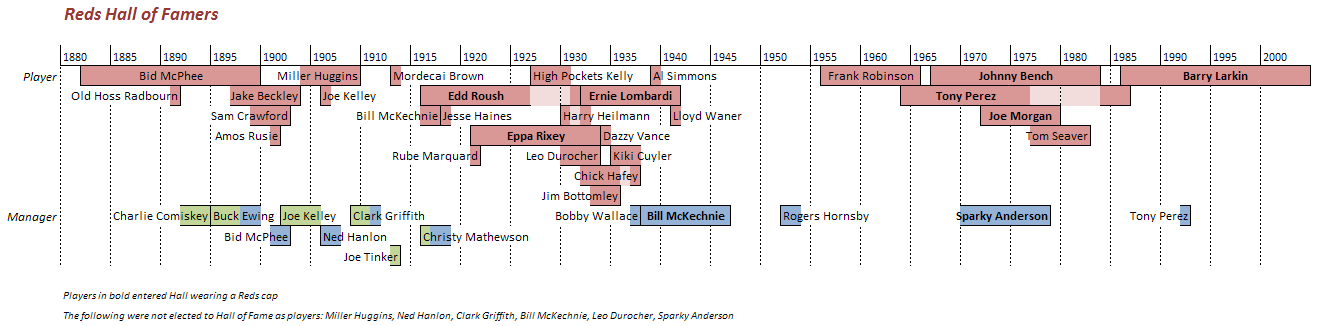
Barry Larkin was voted into the Hall of Fame yesterday.  Seven years ago I wasn’t sure this day would come.  I remember scouring ESPN.com when Larkin retired, trying to figure out if the experts agreed with the entire city of Cincinnati on their shortstop’s Hall of Fame credentials.  I likely turned to Rob Neyer first, though if I remember correctly his take wasn’t much different than most: Larkin deserved to get in, and it wasn’t all that close.  Whether the writers would vote him in is a different story.  As has been chronicled more times than I can count over the last several days/months/years, for some reason Larkin didn’t stand out.  Most commonly, it’s blamed on the fact that he was good at everything, and not transcendently great at any one thing.  My personal bias is that Ozzie Smith’s legend, which I maintain helped him win a couple extra Gold Gloves in his twilight years that probably should have gone to Barry, kept the Reds shortstop under the radar.  Whatever the reason, whenever Larkin’s Hall of Fame case came up, I started sweating.

But a funny thing happened on the way to Cooperstown.  More accurately, millions of tiny little things having been happening and continue to happen, which are slowing beginning to shape the way many people look at baseball.  The internet continues to find new ways to gather and deliver information.  Very smart people who would otherwise have no outlet, now have a voice.  And I think these smart people started talking about Barry Larkin’s Hall of Fame credentials, and then other smart people started noticing.  And soon, even the not smart ones started to think: “Hey, this Larkin guy was pretty good.”  Or maybe they thought: “Wow, everyone seems to like him.  Seems like a good enough reason for a ‘yes’ vote.”  We can’t really be sure.

Point is, in the weeks leading up to the vote, I was much less worried about the results than I had been in the past.  It seemed that support had swelled, and before it actually happened, everyone knew that Larkin would be inducted in 2012 before a wave of great players entered the pool in 2013, 2014 and 2015.

So when it happened, I was happy.  But I was also really busy at work, and when I finally found the time to look out on the interwebs and see what I could see, I got kinda bored.  All these people talking about Larkin as if I didn’t know who he was and what he had done.  Jim Bowden and his lame home video, telling generic stories and recalling his connection to our team when it was convenient for him to do so.  These things did not interest me.

***

Barry won his MVP when I was 12 years old.  Not long after that season I remember going with my parents to the Bigg’s in Eastgate to get a limited edition poster, a full-body illustration of Larkin following through on a toss to a teammate.  I came home and put it up on the ceiling above my bed, not because I wanted to look up at our star every night before falling asleep, but because all my other wall space was filled.  Honestly, though, had it been any other poster I don’t think I would have given it such a front-and-center location.  I ended up staring that that thing an awful lot.  It had his 1995 MVP-winning stats listed along the bottom, which still stand out to me today.  13 homeruns.  66 RBI.  A few years later, when players were routinely hitting 60 and 70 homeruns, it seemed both remarkable and perplexing that Larkin was able to win.  I always though it was funny, too, that the next year he became baseball’s first ever 30/30 shortstop, posted a career best OPS+ of 154 with a .298/.410/.567 slash line, won the Gold Glove, and finished 12th in MVP voting.

***

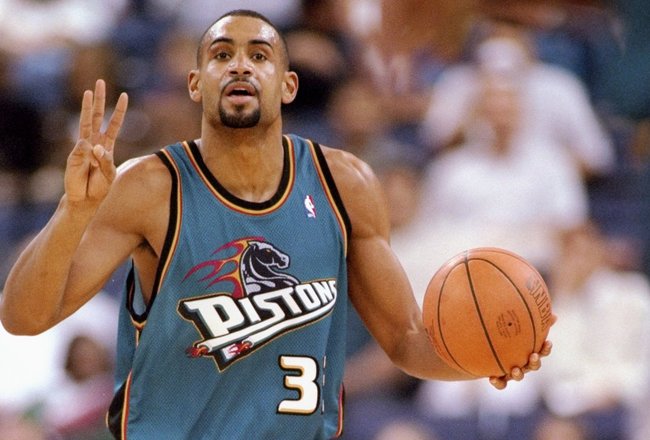
For some reason I never had a baseball jersey growing up.  I had several football ones, but they were mostly afterthoughts (including a Marino jersey that was probably on sale at All About Sports).  In all honesty, basketball was my favorite sport growing up, and my jersey collection was evidence of that.  Aside from the three Nick Van Exel Laker jerseys, my favorite was probably a Grant Hill from Detroit’s short lived teal era.

I do have one baseball jersey now.  Several years ago when I had a birthday coming up, it had become clear to me that I had no Reds jerseys, and that was weird.  I thought of the players on the team, and though my fandom was as intense as ever, no one really jumped out at me as the guy I wanted to wear around GABP.  No, I wanted a jersey that was inspired by greatness, that represented this team’s proud history.  And now, I know exactly what I’ll be wearing in Cooperstown on July 22nd.

Reds Pitching: What happened, and is it fixed?

Most Reds fans will tell you that the big concern this off-season was pitching.  Sure, shortstop and left field are routinely identified as “areas of need”, but those are more of a luxury.  The Reds have solidly been a top 5 offense in the NL the past 2 years.  No, what hurt them last year was pitching, and this isn’t news.  But, if you know me, you know I like to put numbers to pretty much anything, so here you go:

Reds Pitching Compare

This is a basic breakdown of the team’s performance in the major categories: hitting, pitching and defense (and I guess baserunning, but as you will see, that isn’t really “major”).

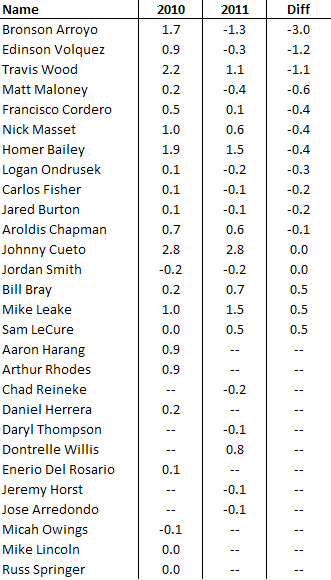
The first thing you might notice is that pitching isn’t the only thing that suffered in 2011.  The Reds’ offense lost more than 6 wins.  Well, that may be a bit misleading.  First, you might assume that even though both Batting and Pitching WAR went down, 33 is still higher than 7.  And you’d be right, by a lot.  This observation also plays out when you compare with the rest of the league.  In 2011 the Reds were still second in the NL (behind the Cardinals) in offensive WAR.  They were 14th in pitching WAR.  The only reason 2011 seems like a drop in offensive output is because the Reds went ballistic in 2010, beating out the second place Brewers by almost 7 wins.  They were a virtual lock to go down in 2011.

So anyway, back to pitching.  Seven wins is not good.  It’s especially disappointing when you consider all the praise the Reds’ staff was getting before the season because of its depth.  Seven or eight viable starters.  When’s the last time Reds had such a stockpile?  One or two are bound to develop into a staff ace!

Reds Pitching Player CompareWell, not quite.  Cueto turned in a good year.  But an injury limited him to 24 starts, and as you can glean from other materials on this site, he may not have quite reached “ace” status.  Mike Leake, Homer Bailey, Travis Wood, and the out-of-nowhere Dontrelle Willis were also not bad, but not enough to make up a division winning middle-of-the-rotation, as the Reds only got 79 starts and 4.9 WAR among the four.

But the real problem with 2011 was Bronson Arroyo and Edinson Volquez.  The pair combined for -1.6 WAR in 52 starts.  Think about that for one more minute.  Nearly a third of the Reds’ starts were spent on guys who cost the Reds 1.6 wins.  That’s not compared to the average major leaguer.  That’s compared to the average replacement player (i.e. someone called up from AAA or random free agent guy).  This is somewhat mind blowing.

But ok, let’s relax a little.  (Breath.)  2011 is over.  2012 is a new year, and the Bronson Arroyo that Reds fans have come to know and love is dedicated to becoming the dependable innings-eater he had been for years.  While encouraging, I don’t think we can count on Arroyo becoming a middle-of-the-rotation guy.  At best he can be a serviceable 4/5.  But I do think he can do it, and there’s at least a chance he performs even better.

So that’s one down.  Next up: Volquez.  He gone (sorry, lived in Chicago too long).  But seriously, I hope he turns it around somewhat in San Diego (not too much though). I honestly won’t be too broken up about it, because no matter what happens, EV’s time in Cincinnati was done.  There was really no coming back from that situation.

So let’s stop dwelling in 2011 and look ahead.  We know what happened in 2011.  What’s going to happen in 2012?  Have the Reds put themselves in position to contend again?

OK, so it’s impossible to say.  But let’s make the best guesses possible.

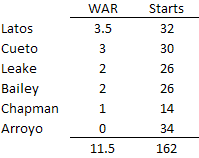
Reds starters went from 11.4 WAR in 2010 to 6.1 WAR in 2011.  Can we return to double-digits?

First, the aces.  Cueto has hovered just below 3 the last two years.  Considering he is still just 26, and we’re hoping for a full season out of him, I’m going to go ahead and give him the 3.  Now obviously he could go higher (we hope), but there’s also the possibility that he regresses/gets hurt again/etc.  3 seems reasonable.

Mat Latos touched 4 wins above replacement as a 22-year-old.  His 2011, when he turned in just over 3, has been documented.  Many think Latos could turn into one of the best pitchers in the NL.  But since there are question marks, I don’t want to count on him for too much here.  I’m giving him 3.5, which could be conservative, but I’d rather be pleasantly surprised than disappointed.

Already we’re surpassing last year’s total.  That leaves Leake, Bailey, Chapman and Arroyo for the last three spots.  Something tells me Arroyo will be making 30+ starts, which is probably fine because we’ve now traded away much of our starting pitching surplus, and Chapman will be a big question mark.  Bailey has been taunting Reds fans for years, but despite his frustrating tendencies, he has shown he can be effective.  I was hoping we’d get a better read on him last year, but that didn’t happen.  He has gotten close to 2 WAR with around 20 starts each of the last two years, so I’m going to go ahead and give it to him.

I’m giving the same to Leake, who is entering just his third major league season, and can be expected to continue to steadily improve.

We’ve covered Arroyo, and as optimistic as I may have sounded, I’m giving him zero wins above replacement.  It sounds low, but consider, that’s an improvement of more than a win – no easy task.  Granted, he was bad enough last year that it shouldn’t be as difficult as it sounds, but the guy is what, 35?  And his strikeout rate continues to go down.

Reds Pitching 2012 PredictionSo where does that leave us (by the way, I gave Chapman ‘ah’ win)?  11.5.  Right around 2010 levels.  Of course, these are very rough estimates.  Anything can happen.

That’s not all though, right?  The Reds now have an experienced 8th-inning guy who will transform the bullpen (or something like that).  Sean Marshall has been a brilliant back of the bullpen guy for the Cubs, and actually had more wins above replacement over the last two years (5.0) than the entire Reds bullpen (4.8).

Every time I think about doing an analysis like this, I start to get discouraged.  That’s because I almost feel foolish making the implication that we have any idea what’s going to happen next year.  What improves our chances though, is focusing less on individual players, and more on the team (you know, law of averages and all that).   So while I might have been more aggressive with Leake and Bailey, I was conservative with the rest, which hopefully adds up to a decent projection.  And of course, we haven’t even touched the rest of the team.  Some of that was by design… much of the offense will stay the same, which means the defense will stay the same.  Maybe Mesoraco contents for Rookie of the Year.  Maybe he struggles.  Maybe Stubbs bounces back.  I will say that there’s a lot of room for improvement.  2011 was a down year.

Topic for next time: why have the Reds so underperformed their expected win total based on WAR?  Dusty Baker anyone?

(P.S. Many of the WAR predictions made here were helped by the very cool player projection tool over at Fangraphs.  You can select certain stats for each player for the upcoming year and it calculates a corresponding WAR.  It includes stats for the last several years to help you out too.  I highly recommend it.)

Basement Baseball

I’m going to go ahead and commit a blog crime by reposting something I’ve written elsewhere. Several reasons are driving this decision.

One, is it really reposting if nobody read it the first time around? Two, with Aaron’s article kind of blowing up thanks to a Redleg Nation link, I feel a desire to give the people (should they ever return) more to read. And honestly, who wants to talk about football, Aaron?

Finally, Josh Wilker wrote about an invented game and it reminded me of our invented game. Josh’s is hypothetical but I believe, put into action, it would be an interesting variant. Is there anything more fun than successfully inventing a game? All of the iterations and tests to get to something perfect. That’s what we’re obsessing over right now, isn’t it? Some game tried and tried until we got to a point that we were satisfied with the challenge enough to pay people millions of dollars to play it in front of us.

So here’s my invented game. Feel free to create a league and talk about my little brother’s wins above replacement.


I am not a sabermetrician. Not because I don’t “believe” in it but because I’m not really smart enough/dedicated to try to understand it. I have read Baseball Between the Numbers and Moneyball (even though that’s not really a book that teaches sabermetrics), so I get the concept and that some of the old ways of analyzing baseball aren’t really accurate.

Despite my sabermetric inadequacies, I do have a friend who gets it and I regularly follow some of his favorite writers, namely Rob Neyer and Joe Posnanski. The latter I do not follow as closely because he is the king of long-form posts. Kind of funny since I’m kind of the prince of verbosity. Willing to write tons of pages about myself but not willing to read any others. Probably says something about me and about why I don’t have a ton of regular followers.

One of the Joe Posnanski posts I managed to break down and read entirely was this one. It’s an interesting post that begins by mocking a writer who used the typical “mom’s basement” term to demean some nerd who understands things a lot better than him. Posnanski goes on to talk about the great games that took place in his mom’s basement when he was a kid. Fun to read about but mostly it reminded me of the games I played with my brothers. Games I hadn’t thought about in a while.

There was one game that I played with both my brothers and, many times, visiting cousins or neighbor kids. We called it Basement Baseball. I think you can kind of understand the premise just from the title, but there were some interesting quirks about the game. First, our basement had those high up basement windows that let enough light in just to remind you that it was daylight out and you were in your basement playing Sega. Because I had actually broken one once and had to pay for it, we made sure to use balls that wouldn’t break the windows. These came in the form of those cheap plush mini balls you get in a random kids’ meal. Ours came from White Castle. Funny, because I never recall actually eating White Castle as a kid.

Historians never documented basement baseball. This photo of Tyler and I hanging out in another basement will have to suffice. Tyler is the one wearing a raquetball racket cover on his head. I was busy writing and had no time for such foolish actions.

Also in the confined quarters of a basement, a regular bat would not work. If you swung it, you might end up bopping the person in the ondeck circle (the bottom of the stairs). So we had to improvise. Our family was way ahead of the recycling curve. Back before there was home pickup of recycling, we used to store our recycling in bins under the basement stairs until the stairs were overflowing and then we’d load up the Ford Ranger (probably sitting four across the front, with the stick shift between one of the boys’ legs) and take it out to Clermont County on our way to the garden and recycle it. I would like to say it was because we were an environmentally concerned clan, but I have my suspicions that it was more a way of keeping from paying for more garbage bins per week. So with a bin full of two liters and Sunny Delight bottles under the steps, we had our pick of Eastons and Louisville Sluggers.

Each “bat” had its own specific qualities. Lotsa Red Pop had a cheaper, thinner plastic. I think this helped envelop the ball and direct it down the third base line better. Big K Sparkling Punch was a tighter plastic and the ball kind of popped off of it. Plus as an added bonus, you were using a pink bat that smelled like strawberry chemicals. My personal favorite was Sunny D. We used it sparingly for some reason. I think we liked to police ourselves and not get too much of an advantage. The ball seemed to go farther off of it. I’m not a physics teacher but I think it had something to do with the size of the gallon bat. It also made the most satisfying “whoomp” noise when you caught the meat of the bat. Gallon milk jugs were the occasional failed experiment due to their lack of a neck and a round body.

The writer taking his basement technique to the backyard. Check out those leg muscles powering through the foul tip.

But the bats weren’t the only unique element these little Doubledays came up with. We also had a strange playing field. Our basement was unfinished for many years and right in the center of the open space was a metal pole. It was clearly an important support for the house but it was a very unfortunate part of Sanderson Field. But as kids with limited construction budgets we made do. In fact it was just a little off center in the basement to the point that we could make it our third base and foul pole. To the right side we had a cement wall where we positioned first base across from the pole. Second base was against the adjacent wall which also doubled as our centerfield and outfield fence. Both first and second were represented by large pillows. I don’t remember the exact rules about fouls and homeruns. I believe if you managed to get the ball up in the windowsill, that was a homerun. Also walls were in play. So there was a lot of strategy to ricochet shots. In fact one method of attack was to get the ball to bounce back into what is normally foul territory. Sometimes if you were lucky the ball could end up buried in the dirty clothes or get stuck behind the toybox in the back corner.

With limited players we of course had ghost runners. Also with limited players we had ghost defense. Instead of forcing an out at first you just threw the ball at the wall. If it beat the runner, the runner was out. But in tag situations, you didn’t even have to tag the runner. You could just bean the runner with the ball so long as they were off the bag. We called these “soakies”. I have no idea about the etymology on that word and as a kid thought it was a universal term. I think this rule benefited my older brother Justin the most because he had an excuse to wing a plush ball at his little brothers without getting into trouble.

The three inventors of Basement Baseball before their moment of genius. I think Justin's jambox as well as the Little Tikes Coupe spent some time in the basement on Heatherglen.

Justin is seven years older than me and nine older than Tyler. At ~14 he was basically an adult to us, so he was required to play the game from his knees. I imagine if he played on his feet he would be able to get from home to first in two strides. I think when Dad participated he played from his knees too. Dad was also pretty good at runner interference. He would reach out his giant adult man arms and just pull you in as you rounded first until Justin found the ball and pegged you with it.

We played Basement Baseball enough that everything was pretty well established including placement of pillows and usage of bats. I think we played long enough that I was eventually big enough to have to play from my knees. It was an awesome game that ended in a lot of stubbed toes or scraped elbows. Then we refinished the basement and created a whole bunch of new memories there. Like windowsill slam dunk contests and knee races around the pool table.

I’ll have to use another post to tell you about another invented game Tyler and I played: Bookseeds (or two man baseball). With preemptive apologies to the Nagys’ lawn.

Football Thoughts

Happy 2012!  This will probably be a rarity, but I would like to indulge in some football talk:

Bearcats Get 10th Win
First, college.  The Cincinnati Bearcats earned a satisfying bowl victory against the SEC on Saturday.  Yes, it was Vanderbilt, and yes, they were only 6-6, but all of their losses were to SEC opponents, and as we all know, the SEC reigns supreme.  For the seniors, it was their first win in a bowl game.  As exciting as two BCS births were in ’08 and ’09, the Bearcats looked overmatched against Virginia Tech and the Tebow-led Gators.

Offensive stars Isaiah Pead and Zach Collaros played their final games in a Bearcat uniform.  Collaros had an accelerated rehab following an ankle injury in November and struggled.  UC fans will surely give him a pass, however, as he has turned in an exceptional career in Clifton, leading the Bearcats to two Big East Championships, coming within seconds of a National Championship birth, and of course bursting on to the scene as a freshman when Tony Pike got hurt.

Pead of course had a great game, living up to his Big East Offensive Player of the Year status, with 150 yards and a touchdown.  I remember when Pead was a semi-big name high school recruit and bypassed tOSU to come to Cincinnati (I’m pretty sure he’s even from Columbus).  While he was always productive, it took him a few years to live up to the hype and gain the role of “feature back”, but once he did, it was quite a show.  Both will be missed.

Bengals Playing in January
The NFL regular season is over.  I went into the year expecting to hardly pay attention.  I even let the will of Yahoo!’s auto-drafter determine my fantasy roster (I did do a little pre-ranking).  But just when I thought I was out, they pull.. me.. back.. in (sorry).  Two rookie stars and a hot fantasy start forced me to abandon my original plans for autumn Sundays, and 17 weeks later the Bengals have found themselves in the playoffs.

Yesterday on WLW Alan Cutler was discussing how everyone would accuse the Bengals of “backing in” to the playoffs if they got in despite a loss.  I understand that on radio (and TV) everything has to be a story with a headline.  After all, hours of talk radio have to be filled.  Pre-game shows that were once an hour are now three.  But honestly, I think the Bengals’ case was going to be overstated, win or lose.  A win versus the Ravens wouldn’t have meant that they “belonged”.  A loss doesn’t mean that they can’t start clicking and get to the Super Bowl.

Andy Dalton has gotten a lot of hype, but I get a little nervous.  Someone on WLW yesterday (can’t remember who) called him a “franchise quarterback”.  Obviously the term is ambiguous, but I think we are getting a little ahead of ourselves.  Two years ago a rookie quarterback led his team to the AFC Championship.  He was not overly heralded, but he did what needed to be done and let his top 5 defense take care of business.  He even did it again the next year.  And now, I’m pretty sure most Jets fans are tired of waiting for Mark Sanchez to be a “franchise quarterback”.  I’m not saying the situations are the same (after all, do you expect Andy Dalton to be in the AFC Championship game in two weeks?), but let’s just relax for a minute. A.J. Green, on the other hand, will be a star – if he isn’t already.

I honestly don’t care how the Bengals got in.  We’re in.  And history will tell you, sometimes that’s all you need.  (Isn’t if funny… as woe-is-me as Bengals fans like to be, this marks Cincinnati’s second playoff appearance in three years.)

Tebow Rant (it’s short I promise)
I alluded to this already, but it’s not surprising that the media can’t handle Tim Tebow.  First he’s going to be a disaster.  Then he’s winning by divine intervention.  Now he’s regressing.  No, people.  He’s been the same person the whole time.  His “methods” worked for a while (and were probably combining with a significant amount of luck), and now they’re not.  I rooted for the guy.  I even bought into the idea that maybe there was this mysterious “something” that cannot be explained by the most expertiest of expert analysts.  But more and more it appears that the something doesn’t exist after all, and it’s likely that the scene in Denver next week against the Steelers will be a sad one, and perhaps even embarrassing (for the Broncos, their fans, and Tebow sympathizers, that is).

UPDATE: Fixed the paragraph stuff with some suggestions from Zach.

Beltran is a Cardinal

Any seasoned baseball fan should have seen right through all the hype the last couple weeks about the Reds winning the NL Central by default.  Admittedly, I definitely enjoyed the talk.  But alas, one player does not a baseball team make, and while Albert Pujols and Prince Fielder are two of the most impactful players in the game, the Cardinals potentially took a big step toward repeating their 90-win performance last year by signing free agent Carlos Beltran.

Consider: in somewhat of a down year last year, for him at least, Pujols turned in 5.1 WAR.  It was enough for the Cardinals to win 90 games, grab the wildcard, and of course they went on to win the World Series (Pujols did go nuts in the playoffs, slugging .691 in 18 games).  Carlos Beltran had 4.7 WAR last year (not helped by his defense at all either).  In one fell swoop the Cardinals have nearly replaced Pujols’ production at barely more than half the cost!

Alright, so no one honestly thinks Beltran can fill Pujols’ shoes.  But it’s a pretty good start, wouldn’t you say?  And how about the fact that Adam Wainwright didn’t throw a single pitch last year.

Obviously there are many moving parts to any off-season, and adding and subtracting a few players’ WAR doesn’t get you an expected win total.  Additionally, without looking into it I’m going to assume that a few Cardinals outperformed expectations last year, and one could expect some regression next year.  But in a year where Albert Pujols walks, adding Carlson Beltran and Adam Wainwright is a good place to start.

Remember, the Cards and Brewers bettered the Reds by 11 and 17 wins, respectively.  I love the Reds’ off-season moves so far, but I’m not putting them as favorites quite yet.

UPDATE: Of course, over at SB Nation, Rob Neyer has done what I just tried to do, only better.

UPDATED: Reds Payroll Pie

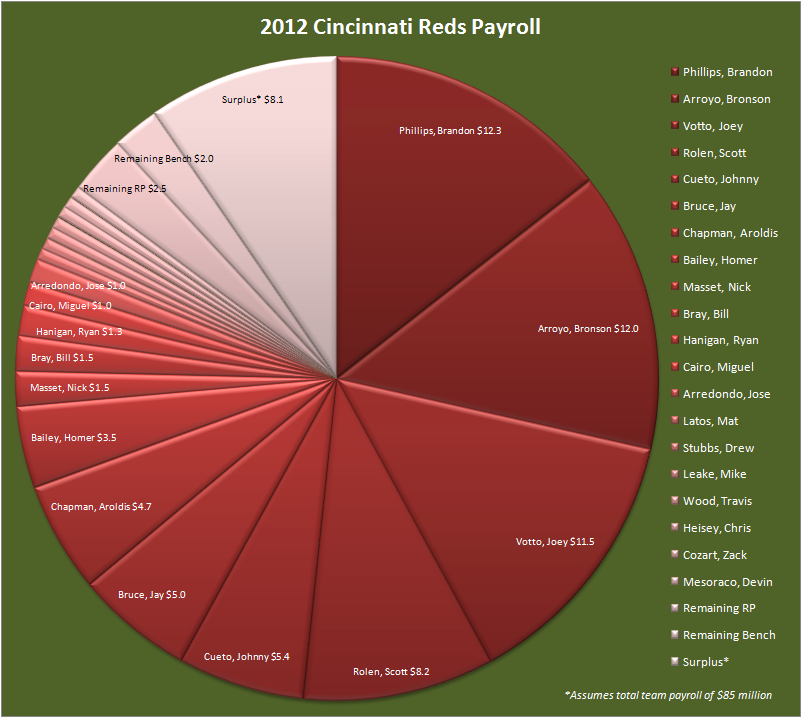
While last week’s payroll pie was awesome and all, there’s no denying that improvements were possible.  Stones left undisturbed.  So, in that vein, I’d like to unveil Reds Payroll Pie 2.0:

2012 Reds Payroll Pie 12-21-11

You’ll immediately notice a few things.  Most importantly, it’s beveled now.

Second most importantly, where uncertainty lay previously, now sits knowledge.  For instance, several players expected to receive significant playing time are up for arbitration.  Without going into excruciating detail about that entire process, suffice it to say that while these contracts are still unknown, one can make educated guesses.  Most notably, Homer Bailey, Nick Masset, and Bill Bray will all earn more than marginal raises.  I have tried to stay conservative with my numbers, but again they are only estimates.

Thirdly, Yonder Alonso and Edinson Volquez are off the books.  It’s hard to notice given all the other changes, but this frees up about three million dollars.

You’ll notice that several pie pieces remain unlabeled.  I decided to delete those off of the main graphic who are expected to play key roles but will be making league minimum (all are estimated at half a million).  Additionally, instead of listing all the additional bench players, or those who may bounce back and forth between Cincinnati and Louisville, I’ve estimated remainder costs for additional reserves and relievers.

Wonderfully, the Reds still have around eight millions dollars of potential surplus (by the way 85 million dollars may be a bit of a ceiling here… somewhere between 80 and 85 is almost assured).  There have been several rumors flying around, including the acquisition of Sean Marshall from the Cubs for around three million.  Also, for some reason Walt Jocketty continues to show interest in Francisco Cordero, with contract speculation coming in at around eight million for one year.  I would be VERY against such a signing, but alas, no one seems to care.

If it were up to me (and others over at Redleg Nation), I would be taking a serious look at Carlos Beltran.

Putting Mat Latos in Perspective

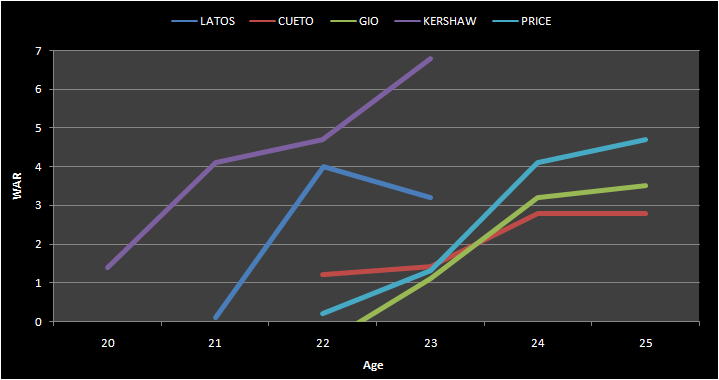
A pretty picture for your perusal:

SP WAR Graph WAR by Age

The above chart is WAR by Age (note the colors assigned to each pitcher… I swear I had nothing to do with it… excel really is that smart).  The players included were selected for various reasons.  I mostly wanted to take the Reds new “ace” and compare him to: the incumbent, the one that wasn’t, the pipe dream, and the National League’s 23-year-old Cy Young winner.

To me, the most notable characteristic here is the grouping of Johnny Cueto, Gio Gonzalez, and David Price.  “Grouping” is used loosely here as no one would really equate those three.  Cueto had a faster start though has leveled off, and surely did not have the credentials to match Price’s coming out of the minors.  Gio had a slightly slower start though is coming on strong and may have marginally better peripherals than Cueto.

Then we have the other two.  Kershaw was included mostly as a comparison point.  I don’t think anyone can expect that type of performance from a pitcher in his early 20s.  It’s pretty impressive.  And then in the middle there’s Latos.  Clearly he had an earlier start than the first three, though his peak seasons don’t quite match what Price has done in each of the last two years, and unlike every other guy his this chart, he actually trended downward last year (honestly, though, I think it speaks to the quality of the pitchers shown that only one has a negative slope at any point… most players will experience this at some point).

There’s a perfectly good explanation for this that isn’t exactly top secret.  In 2010, Latos’ first full season, the Padres unexpectedly found themselves in the middle of playoff contention.  Where they had originally planned on limiting Latos to around 150 innings (rather standard for a youngster’s transition year into the majors) they instead relied on him down the stretch and he ended up eclipsing 180 IP.  He tired late in the year and experienced shoulder soreness which carried over into 2011.  He started 2011 on the disable list and struggled when he returned, opening the year 0-5.  However, as documented in the links provided yesterday, he bounced back considerably (partly due, it is believed, to his increased use of his slider, often referred to as his “out” pitch) and still turned in a VERY nice year for a 23-year-old.

The injury is slightly troubling, as nagging shoulder soreness can really put a damper on a promising young pitching career (Cueto and Chapman have had similar issues).  But Latos’ performance toward the end of 2011 is encouraging.

As much as I like to look at these numbers, it’s easy to get lost in them, overanalyze, and think that you have it all figured out.  There’s no predicting where each player’s WAR will end up next year.  But you have to be encouraged by Latos’ ahead-of-the-curve-edness.  Given the fact that many Reds fans had put a lot of focus toward Gio, and that Price was viewed as ideal but unrealistic, it can be interesting to see how the numbers really play out.  While All-Star caliber pitchers can get their starts at any age, we shouldn’t completely discount the fact that Latos is two years ahead of the other three.  It leaves a lot of room for growth, and the Reds have four years to watch it play out.

We Got Mat Latos, You Guys

On Saturday the Reds traded away Edinson Volquez and prospects Yonder Alonso, Yasmani Grandal, and Brad Boxberger to the San Diego Padres for starting pitcher Mat Latos.  The potential deal Reds fans have been hearing about all off-season is finally here.  Now, what to make of it?

I’ve now read numerous takes on the deal and the general consensus is: Reds gave up a lot; Latos could be very good.

These seem somewhat conflicting, which has been slightly frustrating for this Reds fan.  Though I may also point out, this is the biggest trade my team has been a part of since I’ve been fully plugged into the world of twitter and various other fast-paced media.  Because of this, I imagine that there are more opinions than ever, and added incentive to stand out and be noticed.  Therefore it is our job, as consumers of this media, to wade through it all and make some sense of it.

First, Mat Latos.  Redleg Nation, the Reds representative in ESPN’s SweetSpot Network, has put together a “Meet Mat Latos” post.  It does a very thorough job profiling his career to this point.  Of note: Latos will only be 24 next year, and has 4 years of team control remaining (if you have questions about what this means, the RN post includes a primer on arbitration and what happens to a player before he hits free agency).

Latos is not without risk.  I’ve read things about his injury history and his makeup.  Latos tired down the stretch in 2010 and started 2011 on the disabled list.  However, as the RN post notes, he bounced back in the second half.  One would hope that his big frame leaves him less susceptible to injury than the average pitcher.  I haven’t read too many specifics on the personality concerns, other than a possible lack of maturity when he gets behind in the game.  He also appears to have a large number of tattoos.

Obviously any pitcher has the potential to flame out.  However, Fangraphs founder Dave Cameron gives his take here, where he is high on Latos and the Reds’ move.  There is a table near the top that groups Latos in with a pretty impressive bunch.  His peripherals (which generally refers to K rates, BB rates, and HR rates) are top notch, which bodes well for his move from “cavernous” Petco Park to the GABP.  As has been noted numerous places, his HR rate was actually higher at Petco than it was on the road, and the ERA and FIP differences are marginal (FIP refers to Fielding Independent Pitching, which attempts to eliminate factors that are beyond the pitcher’s control from the evaluation of his performance).  As this article from Fangraphs’ fantasy baseball-minded arm points out, pitching in various away ballparks and pitching every home game at GABP is not the same thing.  However, I think Latos gives us as much reason as possible to be optimistic about the transition.

Keith Law, ESPN’s prospect guru and unrestrained king of snark, also likes the deal (sorry, Insiders only).  He opens with:

The Cincinnati Reds give up a lot of future value, but nearly all of it surplus value for their club, in exchange for a legitimate front-of-the-rotation starter. The San Diego Padres swap quality for quantity in a building move that helps them but doesn’t entirely add up for me.

He notes what those outside the situation seem to be reticent to admit: that while 4 players seem like a lot, each isn’t without limitation.  To me, Alonso is the surest bet to contribute significantly, as he’s had successful major league experience.  However, he is not likely to match his 2010 performance moving forward, and in my opinion the Reds did exactly what they should have done (given an Alonso deal was to be done) and struck while the iron was hot.  Grandal probably has the highest ceiling of the group, but he is still a year or two away, and there are question marks about his defense and whether he can continue catching.

The most negative comments made on the trade came from Buster Olney’s twitter feed:

First rival evaluator I spoke with LOVES the trade for the Padres: “San Diego made an absolute killing with that deal.”

E-mail from second rival evaluator (and don’t kill the messenger): “Overall big win for Padres and huge gamble for Reds.”

Observation of third rival evaluator: “The only way I’m making that trade for Latos is if he has [perfect] mound makeup. And he doesn’t.”

4th scout on Latos deal: Possible strong No. 2 starter, with significant risk. This evaluator says CIN gave up 3 of their top 5 prospects.

More of an FYI than anything else… depends on how much you trust the POV of talent scouts.  However, 3 out of top 5 prospects is a bit of a stretch.  According to Baseball America the trio was #3, #4, and #10 in the organization.  Also feel free to check out SB Nation for a slightly negative slant on the move, including Rob Neyer’s non-endorsement (which makes me sad).

In conclusion, I will leave you with this: yesterday I was thinking through what I wanted to write in a Mat Latos piece.  Well, when I read this Redleg Nation post I realized I was too late.  It gives an excellent overview for what the trade could mean for the upcoming season.  (By the way, I highly recommend RN for any Reds fan.)

I would like to follow this up with a deeper look at some of the numbers, so be on the lookout in the next several days.