I realize that this topic will not interest everyone, and in fact may be the most limiting thing I’ve written about so far when it comes to audience appeal. I’m going to go ahead and apologize now because this is fairly self-indulgent, and very nerdy. I’m also going to apologize to Zach for plopping this down right in between his movie month intro and the subsequent followups. However, this has just been on the forefront of my mind, and I have confidence Zach and his wonderful idea will rebound.
I have been playing fantasy baseball since college, and my involvement has gone through several stages. I don’t really remember my first fantasy baseball league, but I’m going to assume I was pretty pumped about the idea of being in charge of my own team, drafting players and setting lineups. I’m pretty sure these are the same reasons most people get into it. And as most serious fantasy baseball participants soon discover, some of our favorite aspects of the game aren’t fully captured in your most basic fantasy league: setting the batting order, evaluating prospects, deciding how much value a player loses when he undergoes Tommy John surgery. So of course, we search for more.
I don’t really remember the first time I joined a keeper league, but I’m going to assume it was pretty soon after I joined a non-keeper league and realized how much awesomer keeper leagues sounded. And it didn’t take long until even that didn’t satisfy me. I wanted to build a roster, contemplate middle relievers, and not have every guy in my starting lineup bash 20+ homeruns. So I did the only logical thing and joined a 30-team sim league.
I’m going to pump the breaks a little here. I don’t want to get too far into this, partly because my apology at the beginning of this post would be a severely sub-sufficient warning for what would transpire. I will say that I spent hours and hours looking at every major league player’s three previous years of stats, ranking every position. And by the way, this is weird to think, but I’m realizing as I type this that it doesn’t sound as crazy now as it would have in 2003 when I was doing it. I won’t speak definitively on the nature of the universe of baseball stats and analysis, but at least to me, it was nothing like it is now. No Fangraphs, no exportable stats, no easy and convenient way to get everything in one place. I remember I spent one summer vacation pouring over pages and pages of printouts, taken from ESPN’s stats pages and sloppily copied and pasted into Excel.
But anyhow, hopefully some of your faith in me is restored when I tell you it didn’t take much more than a season for me to determine that it wasn’t sustainable. Perhaps the realization that I was in college and shouldn’t spend hours alone in my room played a part, I dunno. But let’s get back to the point.
The point is, despite the ups and downs, I would never lose the desire to build my own successful baseball team. Generally speaking, my fantasy baseball involvement has leveled off somewhat to a place I’m comfortable with. Specifically speaking, Fangraphs introduced a fantasy game last year with stat categories deviating from the norm, and that’s sort where all this starts.
For a while now I’ve had this end-goal in mind when it came to evaluating players for fantasy. Yes there are tons of rankings out there, and even some that give you auction values and yada, yada, yada. But honestly, I’ve wondered where those came from. How do they come up with a dollar value for what a player is worth. Any maybe it’s not such a difficult question on an abstract basis, but if I literally wanted to start writing formulas and crunching numbers, how would I do it. This became even more necessary when I joined a Fangraphs league, because most rankings out there consider stolen bases and wins, and those were stats I needed to completely ignore. What had been a dream was going to have to become reality: I needed to develop my own system for valuing players.
Whenever I had attempted to tackle this topic, my idea had typically centered around the idea that every run, every homerun, has a dollar value, and as a player accumulates these stats, he accumulates value. For counting stats this is somewhat simple. How many homeruns are hit in the National League? How much money do you have to spend? Some quick division and you have a dollar value per homerun hit. Obviously there’s a lot more to go through but the general idea is there.
Rate stats threw a wrench in it all. Players don’t accumulate on base percentage. How do you give a dollar value to a percentage point of OBP? And really, more importantly, you can’t just consider pure OBP because it doesn’t account for playing time. A starter with an OBP of .360 obviously has more value than a bench player with an OBP of .360. Additionally, a player with a .220 batting average doesn’t add value. Logically speaking, there is a point at which a player’s batting average is low enough that it hurts his value. And if you think about it, this is true for counting stats as well, though I didn’t realize it at first. When Juan Pierre is on your team, he generally helps in stolen bases and average (stick with me here, I know he’s old). But his homerun and RBI totals are deficits to your team, and it all contributes to the net value that he provides. I realized that instead of benchmarking every player at zero, the benchmark should really be a league average, and to the extent a player is above or below that average in a given stat category, he adds or subtracts value.
What I would like to do now is show you what I’ve started doing, and then reveal an interesting result that came out of my league. Like I said before, this is somewhat self-indulgent, but I also see it as documentation, as well as an opportunity to share some knowledge/ideas to whomever wishes to consume it. Finally, if you see anything that doesn’t make sense, or you want to yell at me about how much of an idiot I am, I welcome that too.
First I will tell you that this Fangraphs league includes runs, homeruns, on base percentage, and slugging percentage for offensive players. There are 12 teams in the league, with each team allowed 40 roster spots and $400 dollars to spend. Let’s start with runs and homeruns.
Actually, let’s stop here to remind ourselves that there must be several assumptions that go into a process like this. The first, and possibly most important, is the data source. I am trying to predict 2012 value, so I need 2012 stats. The obvious problem here is that there aren’t any yet. So of course I go to trusty ol’ Fangraphs who generously provides us with projected 2012 stats thanks to RotoChamp.
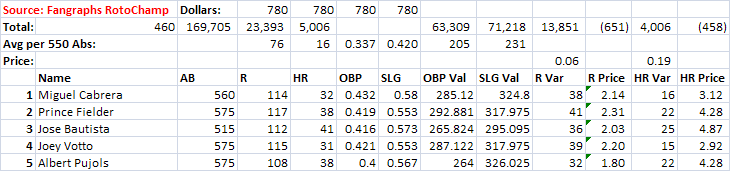
With that out of the way, let’s say we want to determine how many dollars Prince Fielder’s league-leading 117 runs are worth. As I mentioned before, you might first decide that the place to start is determine how much a single run is worth. However, we can’t simply look at a single run out of context. If Prince Fielder were to score 1 run the entire year, he would actually provide negative value. Instead, we need to compare his aggregated total to that of the average player. To do this, I introduced our second assumption, which is that the average number of at bats for a typical major league starter is around 550. I honestly don’t have a lot backing that up. I mostly based it off of the idea that 600 AB is a full season, and then I wanted to account for routine off days, minor injuries within our pool of players, etc. (I might also argue that what this exercise is really doing is calculating relativities, so the exact number I picked here doesn’t really matter much.)
Ok, so what we’re left with to compute the average number of runs is:
- Take the total number of runs for the entire league (23,393)
- Divide it by the total number of at bats for the entire league (169,705)
- Multiply by 550 to get 76 runs (all numbers from RotoChamp projections)
This is the average for the league. Clearly, Fielder is projected to be above average for this particular category, while other players will be only slightly above average, and still others below average. So, instead of assigning a value to the run itself, we are going to assign a value for every run above or below the average. The first step then, is to determine how many above average and below average runs there are. I do this by taking the absolute value of each player’s total runs minus the average (in Fielder’s case the result would be 41).
Next, sum up number of runs above and below the mean (13,851). And finally, we can assign a value, which brings us to assumption #3. I mentioned before that each team has $400 to spend, which results in a league-wide total of $4800. Since there are 4 hitting and 4 pitching categories, we could just divide $4800 by 8. Problem is, that is essentially stating that a fantasy player should spend the same amount on hitting that he does on pitching, which probably isn’t the case (I sort of file this idea under “fantasy rules that are mostly assumed”, but I believe the reasoning is that pitching is much less reliable/predictable… there are probably other reasons too).
So what I wanted to do was determine a split between hitting and pitching dollars. I did this by taking ESPN’s auction values from last year and calculating how much they allocated to hitters and pitchers, respectively. This resulted in about a 65/35 split between hitting and pitching, so I divided the league’s dollars accordingly: $3120 for offense, $1680 for pitching. Now, I think you can argue that each category within hitting and pitching are worth the same (I can’t think of any reason why they wouldn’t be) so I divided each number by 4 to get a dollar amount per category.
Back to runs. We’ve now determined that there are 13,851 runs above or below the average, and that $780 league dollars will be spent on the category. Some simple division (780 / 13,851) tells us that each marginal run is worth 5.6 cents (we’re almost there I promise). Now multiply 0.056 times each player’s number of runs above or below the average, and you get a dollar value for that player’s run stat (be sure you use the actual difference this time instead of the absolute value because we want to reflect players who contribute negative value due to their low run totals). For Prince Fielder, we get 0.056 * 41 = $2.31. You will see later that there are actually a few more league-wide adjustments to make based on roster size and total league dollars, but for now our run component is done.
This same process is done for all counting stats. I included a portion of my spreadsheet below to provide a visual. In part 2 I’ll cover how to adjust the calculation for rate stats, and how we come up with final dollar values. Thanks for reading.