Playing with Fangraphs’ Positional Power Rankings

If you haven’t caught on yet, Fangraphs is awesome.  And well, they’ve done it again.  They took a great idea, and executed it beautifully.

This time of year, everyone puts out some sort of predictions/rankings/etc, and to be honest, I’ve gotten tired of them.  But of course, Fangraphs puts a different spin on them and made it interesting again.

How’d they do it?  First they broke it down by position and ranked every team, 1 through 30.  Second, they considered all players currently slated for playing time at the position, not just one guy.  This allows platoon situations, or rookies who may get more playing time later in the year, to factor into the equation.  Dave Cameron gives a more detailed explanation in the intro, but they basically used a combination of ZIPS projections and fan evaluations of defense to come up with an aggregate WAR for the position.  Numbers were typically ballparked and I think “ties” were broken by the evaluator.  What resulted was a ranking for each position that was built on objective analysis, but also maintained the human element.

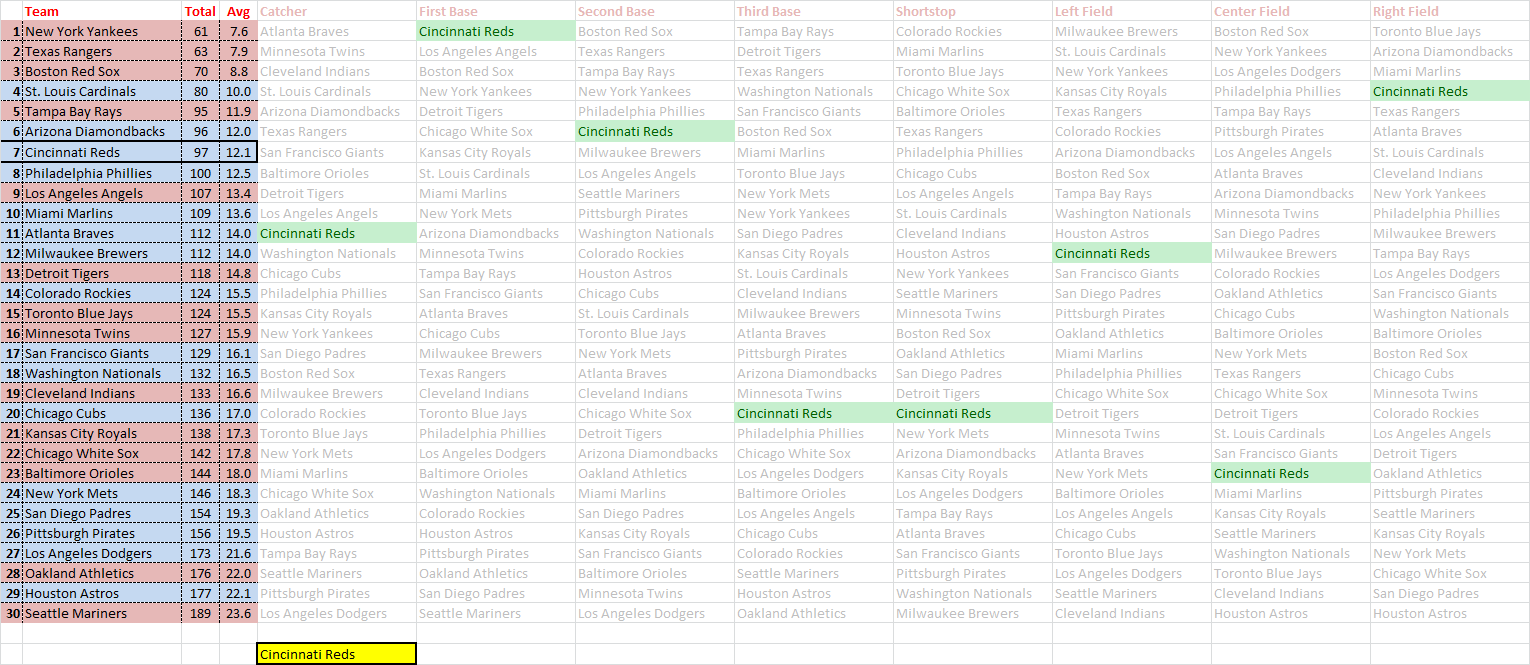
Intrigued by the results, I decided to collect the rankings for all offensive positions and create an aggregate number by adding each team’s rank for each position.  I initially included offense only, as combining hitting and pitching often gets messy (plus there were only two pitching categories and I would have had to do some sort of weighting).  Results are to the right.

Not surprisingly, the American League dominates the top of the rankings, with New York, Texas and Boston nabbing the top three spots.  The Phillies, perhaps the NL’s best bet in recent years to compete with the offenses of the AL on paper, clock in at number eight, just behind your Cincinnati Reds.  The Phillies are getting older, and Rollins, Utley and Howard are developing extensive injury histories.

The Reds show well here thanks to three top 10 finishes (I’m sure you can guess who they are – though full results are below) including the number 1 first basemen(!), with Votto edging out Pujols thanks to the latter’s likely, though limited, appearances at DH this season.

As you can see, those damn Cardinals find themselves ahead of the rest of the National League.  Somehow they just continue to reload, thanks, in part, to a timely Beltran signing (sad face).  The Cards have few holes, if any, claiming a top 5 ranking at two positions (Molina, Holiday) and a top 10 ranking in another three (Berkman, Furcal, Beltran).  Their biggest weakness is in center, where Jon Jay still ranks two spots ahead of Stubbs.  I think it’s tough to have anyone other than the Cardinals as division favorites right now.  Even with the Carpenter situation, we saw how they dealt with Wainwright’s injury last year, and they are pretty strong one through five.  Additionally, Fangraphs is giving 75 innings to prospect Shelby Miller.  The guy just turned 21 and has ranked among the top 10 or 20 prospects in baseball for a couple years now.

It’s interesting seeing how all the teams stack up.  I don’t think there are a whole lot of surprises here, but I’ll let you decide for yourself.  You should browse the entire series, as there is tons of info that you know is going to be as reliable as anything else out there.  I’ll also include my graphic that includes all rankings at all positions, with the Reds spots highlighted, of course.
One thing we’ve yet to address is pitching.  I figured it didn’t require this sort of effort since it’s basically two numbers (starters and relievers), but it is worth considering.

Obviously there’s high hopes for the Reds’ staff this summer.  The addition of Mat Latos, the continued growth of Cueto, Leake and Bailey, the bounce back of Arroyo, and the eventual inclusion of Chapman, all leave room for optimism.

Unfortunately, ZIPS disagrees.  The Reds land at number 23 in the starting pitching rankings, and even Dave Cameron admits that he was “shocked”.  As he puts it, “ZIPS is just not a big fan of Bailey or Leake, and top top it off, it hates Bronson Arroyo with the passion of a 1,000 burning souls.”  Maybe not surprising given his spring performance thus far.  Even Latos doesn’t stack up against other teams’ aces.  Cameron hypothesizes that the Reds will outperform this projection.  (Another surprise was seeing the Diamondbacks at number 21.  You just never know with these projections, and pitching is especially difficult to forecast.)  Thankfully, our revamped bullpen comes through in the clutch, checking in at number 3.

In the end it’s just another set of projections, and they can be wrong.  Wait, check that, they will be wrong, in one way or another.  Which again, is what makes it all worth watching.  It looks like the Reds come out pretty decently, which may not be the enthusiastic endorsement fans are hoping for, but it certainly could be worse.  This is an exciting team with a lot of upside, well positioned for a run at the Central.
Realignment

If you really like baseball, you probably know that in 2013 the Houston Astros will be moving to the American League West.  I had always heard that the idea of making two fifteen-team leagues wasn’t feasible because it would mean year-long interleague play.  Well, I guess they finally decided that was a fair price to pay for giving “equal” playoff access to all Major League teams.

I’m on board with the change, and all NL Central fans should be.  For seventeen years we’ve been competing with five other teams for a division crown while AL West teams had just three other competitors.  Beyond The Boxscore did a brilliant job outlining how realignment (and the extra wild card) will alter the playoff chances for each team (assuming all else is equal – there’s that word again).  Long story short, it will make a lot more sense in 2013.

For a while now, however, I’ve played with the idea of realignment on my own, imagining what I would do if I was the commissioner of baseball.  Obviously many ancillary questions come along with that, in particular, how to deal with uneven leagues.  We all remember the contraction conversations that took place around the turn of the century.  It seems clear now that it won’t be a solution to league imbalance anytime soon.  Which, before resorting to two 15-team leagues and season-long interleague play, left only one other option: expansion.

That may seem weird to some.  The Florida clubs can’t sell 10,000 tickets on a weeknight in August (before the Marlins’ new stadium, that is) and I’m telling you baseball needs more teams?  Well, I’m no expert, but from what I read (and I remember Rob Neyer writing about this more than anyone), just because baseball isn’t working in one state doesn’t mean there isn’t demand elsewhere.  I know Rob is biased due to his residence, but he’s often wrote of putting a team in Portland.  I’ve also heard of places like Charlotte, New Orleans, and Nashville.  I have no idea if baseball teams could survive, let alone thrive, in these places.  I’d imagine, as it would for most places, that it depends on countless factors that many people other than myself would have their hand in.  Regardless, I’m going to assume here that it could work.*

*There are other issues with expansion, of course.  I honestly don’t like the idea of it in general because it just waters down the overall talent of the league.  Plus, to me, it makes baseball just a little less baseball-y.  I’m no traditionalist, but at some point I like the idea that baseball is different that other sports and doesn’t have teams that fans sometimes forget even exist.  Charlotte Bobcats?  Atlanta Thrashers?  (Oh wait, they don’t exist anymore.)  I think baseball has enough teams.  We don’t need more starting from scratch, trying to build up their fanbase (see the story from earlier this off-season of the Nats owner going off about Phillies fans taking over his home ballpark for an example of what I mean – I read a good piece on SB Nation, I think).

Anyway, I’m going with expansion, and I’m going with Charlotte and Portland.  Another thing I always liked, is the two-division format within each league.  Again, I was doing this before the extra wildcard, so one reason I liked two divisions is because it gave you a greater chance that the four best teams would make the postseason (assuming two division winners, two wildcards).  Additionally, a team that won its division wouldn’t start the playoffs on the road.  And and, for some reason it bothers me when divisions get so small (like in football).  I like them big, and I like playing two-thirds of the league more than six times a year.

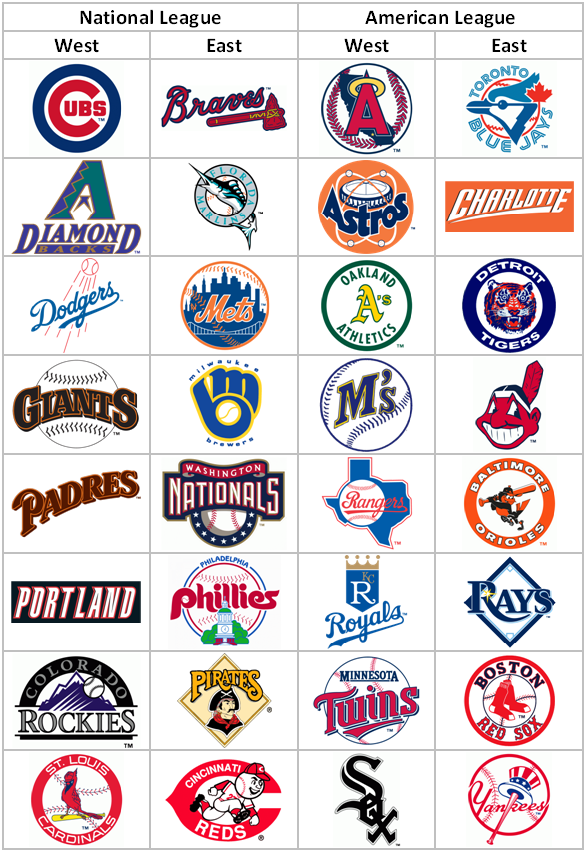
So, we have a basic format: four divisions, eight teams in each division.  Here’s how it all played out in excel.  Comments after the graphic.

All graphics courtesy of sportslogos.net

As I’m sure you noticed, these aren’t all current logos.  I decided to use them from the last time baseball had four divisions.  It was funner that way.

First, I put the Astros in the American League.  I honestly can’t remember if I did that on my own before baseball decided it, but either way, I kept it.  That way I can put one expansion team in each league, and decide where they go based on geography and need.

Basically, when you’re going from three divisions in each league to two, the issue is splitting up the two central divisions, which can be tough.  The easiest call is probably putting the Astros in the West, followed by Pittsburgh in the East.  It’d be pretty difficult to justify Kansas City going east.  Same with the Twins.  Conversely, Detroit and Cleveland are clearly leaning that way.

This leaves Chicago, Cincinnati, Milwaukee, and St. Louis in the National League, and only Chicago in the American League.  To me, it doesn’t make sense to have the two Chicago teams assigned to different halves of the country.  I know baseball has done a lot weirder, but this is my league and that would drive me nuts.

I think you also need St. Louis in the same division as the Cubs.  Putting these teams in the East doesn’t make sense, as it would force Cincinnati or Milwaukee, teams located east of St. Louis, into the West.  So, Cards and Cubs in the West.

It would be tempting to throw the Brewers in there with them, except there’s a problem.  Putting the Cubs in the West forced the White Sox westward, which fills the AL West’s quota for teams.  This means that Charlotte goes to the AL and lands in the East, forcing Portland to the NL West, and all of a sudden the NL West is capped out too.  So Milwaukee, you’re with us Reds in the East.

As a Reds fan I like this setup.  I’ve always missed the Reds/Braves matchup from the old NL West days, and while I would have enjoyed a Reds/Dodgers reunion, that’s an awfully long trip.

Now a word on the logos.

We had this poster in our basement for the longest time that had the 26 teams (yes, 26) all sorted by division.  I loved that poster and probably stared at it a lot (mostly trying to figure out what the hell the Expos logo meant – the coloring threw me off).  Certain icons are burned into my memory: the Phillies maroon “P”, the Brewers ball-in-glove, Chief Wahoo’s giant grin.  Well to me, that poster represents a time when baseball had four divisions, and I wanted to go back to it.  A couple of awards…

Most Improved
Nominees: Astros, Blue Jays, Brewers, Orioles
Winner: Brewers – possibly the greatest baseball logo of all time.

Biggest Mistake
Nominees: Diamondbacks, Padres, Pirates
Winner: Diamondbacks – the worst offender of the purple and turquoise era.

Some additional notes…

Did you notice that the American League has a lot of circular logos?  Ten versus the NL’s five (six if you count the Marlins).

I didn’t follow any hard and fast rule when it came to selecting old logos.  I mostly went to the early ’90s, and if there were several to choose from, I picked my favorite.

The Padres was the toughest call, as they changed things up slightly in 1990, ’91, and ’92.  I had ’92-’98 in there first, which had eliminated all brown and added a pinstripe-y look, but after some thought I went back and opted for brown.  It’s classic.

As I mentioned before, to do this I used sportslogos.net, which is an awesome site that has everything.  Most of the time I would go to the search bar, type in the nickname, and the appropriate team (along with several other related teams) would show up in a table below.  However, I had to mention that only with the Pirates did I have to scroll down several rows to actually get to the Major League team I was searching for.  Poor Pirates.

The one exception to my logo selecting was probably the White Sox.  They introduced the current black and white theme in 1991, and in most cases I would have opted for the generally more interesting look of the previous logo.  But that would have meant going with the light blue and red and the weird looking batting guy, I never really liked that.  The black and white is slick, if you ask me.

Love that the Blue Jays are going retro this year.  They may have been my favorite in the chart above if it wasn’t for the Brew Crew.

For some reason it seems that younger teams like to change stuff around a lot.  The Astros, Mariners, Blue Jays, Angels, Diamondbacks and Rays have all gone through several looks, usually including at least one major color theme change.  The Royals and Mets, however, are the exception.  Their logos are virtually unchanged since their inceptions, and I kind of like that.

I don’t remember that Phillies logo, at all.  But if they tell me it was the primary logo in 1990, I’ll go with it.  It’s sort of incredible, when you look at it, with the shrubery and all.

And I just have to say, that when I clicked on the big version of the Cardinals logo, something struck me.  That is an awfully surly looking bird.  It fits, I guess.