In the early days of this blog, I decided to KISS (keep it simple stupid) and submit a few shorter, more casual posts for general consideration (or at least I tried… you will see that I mostly failed here). In this one, I would like to do some very quick, very high level analysis of the start of Joey Votto’s promising career.
I’ve already used terms like WAR (wins above replacement) in a previous post, and I apologize if I don’t take the time to explain what it means. For one, I feel like it implies that I’m an expert which I definitely am not. Two, sites like Fangraphs or Beyond the Box Score already have fantastic primers on these topics, if you care to learn. Suffice it to say now that WAR is a quick and easy way to evaluate a player’s season while taking into account lots of different factors (such as baserunning, park factors, other players in the league he’s playing in, etc). While it is far from perfect, when it comes to using a single stat to evaluate players, it comes in very handy. Also, think of it as an accumulating stat. For instance, if Joey Votto tallies 6 wins above replacement in 2011, and 8 wins above replacement in 2010, you can add those together to calculate his total WAR across those two seasons.
Now, with that in mind I am going to utilize a tool on Fangraphs that is legitimately awesome. Allow me to show you:
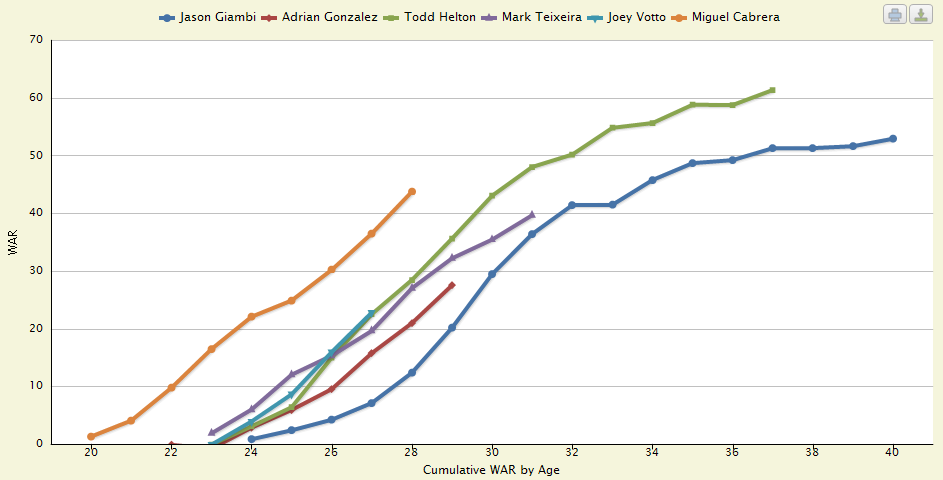
This graph shows cumulative WAR by age for each player. Using Miguel Cabrera as an example, he earned 1.3 WAR in his first season, at age 20. At age 21 he gained another 2.8 WAR, netting him a total of 4.1. Each year in the graph, the player’s additional WAR is added on to his career total.
This type of graph can be used to compare players’ career tracks. For instance, going back to Cabrera, he clearly had an earlier start than the other players I’ve included (speaking of, I just selected a few high performing first basemen of the last 15 or so years). While his slope doesn’t appear all that different than Mark Teixeira’s, the fact that he did it about 3 years earlier in career is pretty meaningful. Most obviously, Cabrera’s head start will give him the opportunity to accumulate more WAR throughout his career. Secondly, his impressive performances in his early to mid-20s is an indicator of the special player that he is. It is much easier to find a player who starts in his mid-20s, peaks, and then begins to regress, than it is to find a player who starts producing at a high level in his early to mid-20s (you may notice that Teixeira, while still a very good player, has begun to trail off a bit).
Obviously nothing is a guarantee. Cabrera, who is battling weight/alcohol issues, could hit a wall at 30, as so many players do. Teixeira could continue to bounce back a bit.
Getting back to Votto, what is neat about this graph is it provides a visual representation for the start of his career. Did he get a late start? Was he in line with his peers? A few things I notice:
- As someone familiar with the Reds, I’ve heard the notion that Votto got a late start, or rather, the Reds kept him in the minors too long (I think Votto himself has danced around this opinion). However, this graph shows his early career to be no too much different than Teixeira’s or Adrian Gonzalez’s. On the flipside, you can see that the past 2 years have catapaulted Votto well ahead of those guys after their respective age 27 seasons. This could be an indicator that had he started playing regularly before age 24, he had it in him to peak a little sooner.
- As we’ve already covered, Miguel Cabrera has had a pretty impressive start to his career. If he can keep himself together he could be a no doubter for the Hall of Fame.*
- My selection of players was off the top of my head. I didn’t include Pujols, because while remarkable, his career path is beyond compare (I recommend adding him in yourself though). Giambi is an interesting case because of the whole PED issue. I still thought looking at his curve would be interesting though. He had his best years around age 30, which is atypical.
*Looking at these graphs reminded me that I’ve read articles around different WAR thresholds and what they mean for a player’s HOF credentials. I am going strictly off of memory here, but I think 80 WAR is typically a ticket-puncher (unless you’re caught up in the PED business), 70 WAR gives you a pretty good shot, and 60 WAR at least gets you in the conversation. Again, I could be totally wrong, but I think that’s close. And of course these are just guidelines and it could differ widely by position, era, etc.
Here’s another graph:
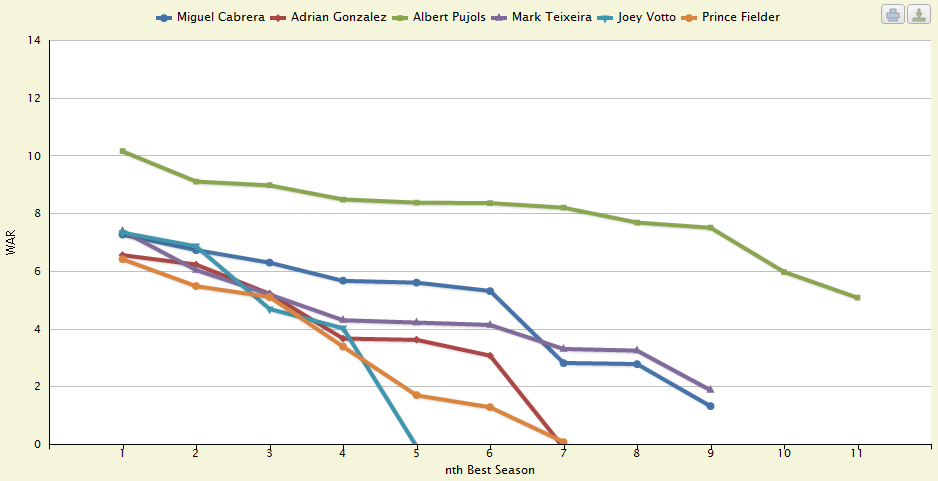
This one tells a slightly different story (I changed the players around too). Here, each player’s seasons are ranked from the highest WAR to the lowest, moving from left to right. For instance, we see that Albert Pujols has turned in a 10+ WAR season. This graph doesn’t tell us when or how old he was, but that was his best year. A season that appears to be just over 9 WAR was his second best, and so on.
Votto shows up well here. Despite having only four full years in the league, his top two seasons match up with anyone’s, save Pujols. I was a little surprised how close he was with Cabrera. A couple more seasons like 2010 and 2011 and Votto will be on his way to establishing himself as the clear #2 hitter in baseball.
I will leave you here for now. The link below will take you to the Fangraphs page… as you can see I added a few players. It’s a pretty fun tool.
http://www.fangraphs.com/graphsw.aspx?players=547,1744,818,1908,432,1281,4314,1177