Another look at contracts

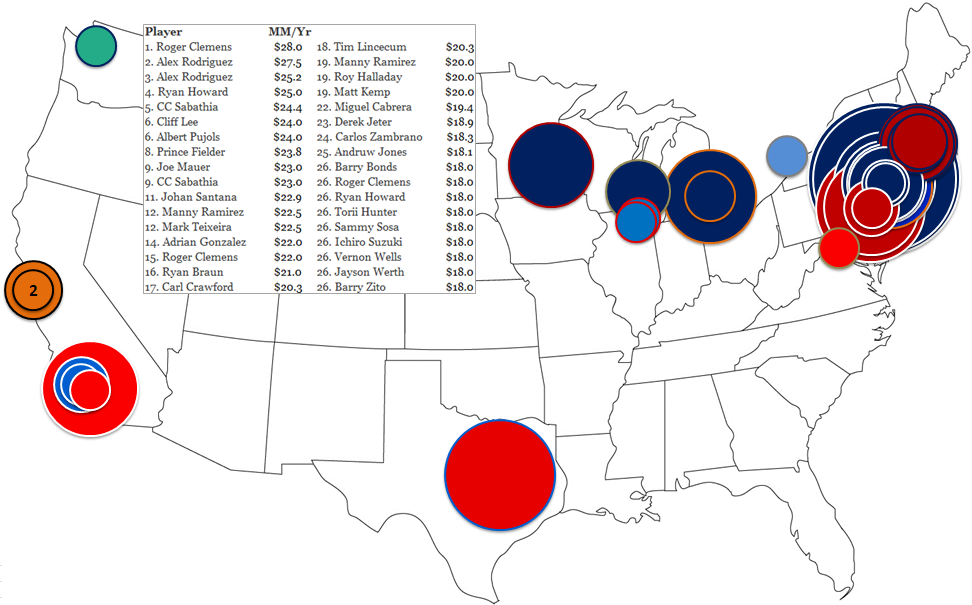
On Wednesday I submitted a map that attempted to show the highest total value contracts in Major League Baseball history.  Predictably, New York was pretty crowded, but overall it played out well.

Yesterday, Twitter acquaintance Joel Luckhaupt (@jluckhaupt) wondered aloud what a map using the highest annual average contracts would look like, so I thought I’d find out:

Avg Ann Contract Value Map

Compare to previous map, if you like.

Some new teams are represented (Seattle, Milwaukee), though more were eliminated, which makes some sense considering dollars per season is a little more difficult for the mid and small market teams to get in on.  Overall it looks fairly similar in most cases, with the northeast getting even more attention.  There is less differentiation between bubble sizes this time around since we were working within a range of $18 – $28 million instead of $100 – $275 million.  Also kind of forgot about those one-year Clemens contracts.  Funny.

An enjoyable and enlightening process, again.

Pujols, Fielder Contracts Pierce Top 5

Until Joe Mauer signed with his hometown team last off-season, the five richest contracts in baseball history were signed by active Yankee players (note: one was actually signed by A-rod to play for the Texas Rangers, but of course he’s now in pinstripes).

This off-season has brought three new faces into the top 10, including the third and fourth highest total value contracts ever.  In December the Angels locked up Albert Pujols for the next 10 years, and yesterday Prince Fielder and the Tigers agreed to a 9-year deal of their own.

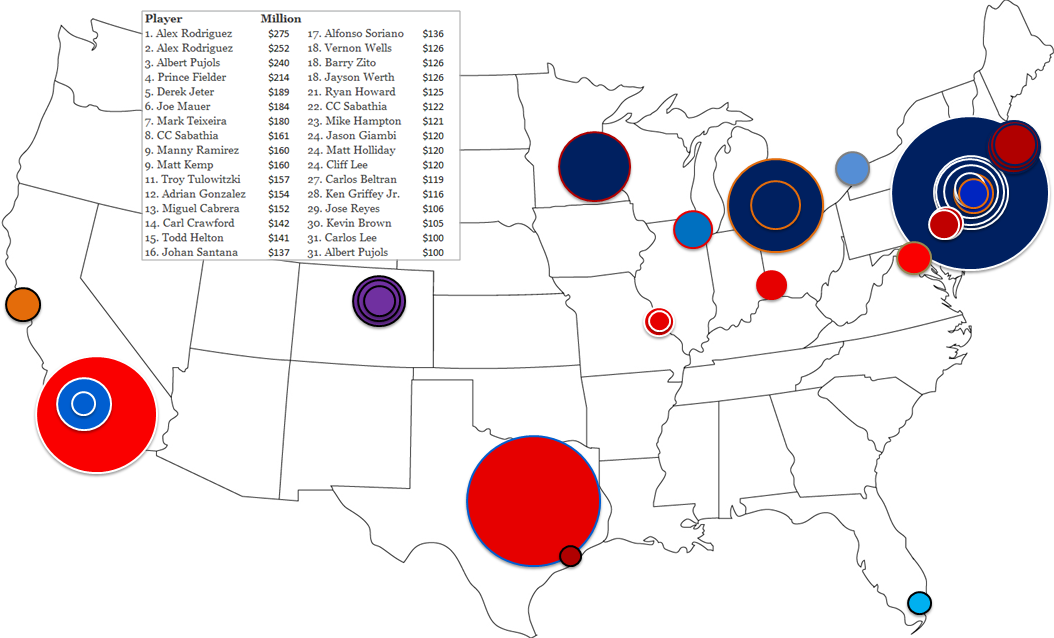
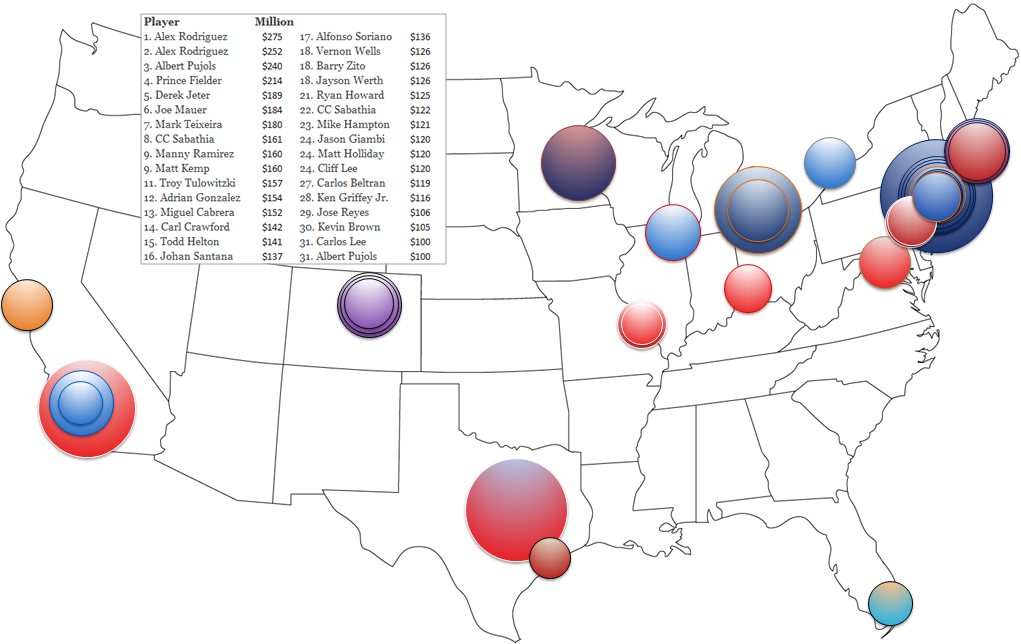
Given my affinity for maps, I started to wonder what it would look like to somehow capture the magnitude of baseball’s largest contracts in geographical form.  Here’s what I came up with:

32 Highest Contracts in History

UPDATE: The original map has been moved to the bottom of this post and replaced with this guy.  There are two reasons for this.  First, I had originally meant for each bubble’s *area* to correspond to the value of the contract, but thanks to some haste and some faulty thinking, I embarrassingly linked the contract value to the diameter (math degree: revoked).  However, after then realizing that sizing by area actually decreases the contrast in bubble size, I just ended up squaring the contract values and using those relativities.  At this point I don’t know that it has a mathematical meaning, but it makes for a more aesthetically pleasing map, and it’s easier to place the bubbles on top of each other.  New York is already overcrowded.

The second reason for the update is blog partner Zach weighed in with a new idea on bubble format, and I liked it.  Again, the original is below in case you’ve grown attached in the last 18 hours.

Each bubble represents a contract, with the size of the bubble being determined by the size of the contract, and the color and location of the bubble corresponding to the team.  I felt that labels would only muddy it up, so I listed the players/contracts represented in the top left.  I’ll let you match up contract with team.

Notable teams not represented: White Sox, Braves, Mariners.

Not surprising: Rays, Royals, Pirates, Athletics.

Original:
32 Highest Contracts in History

UPDATED: Reds Payroll Pie

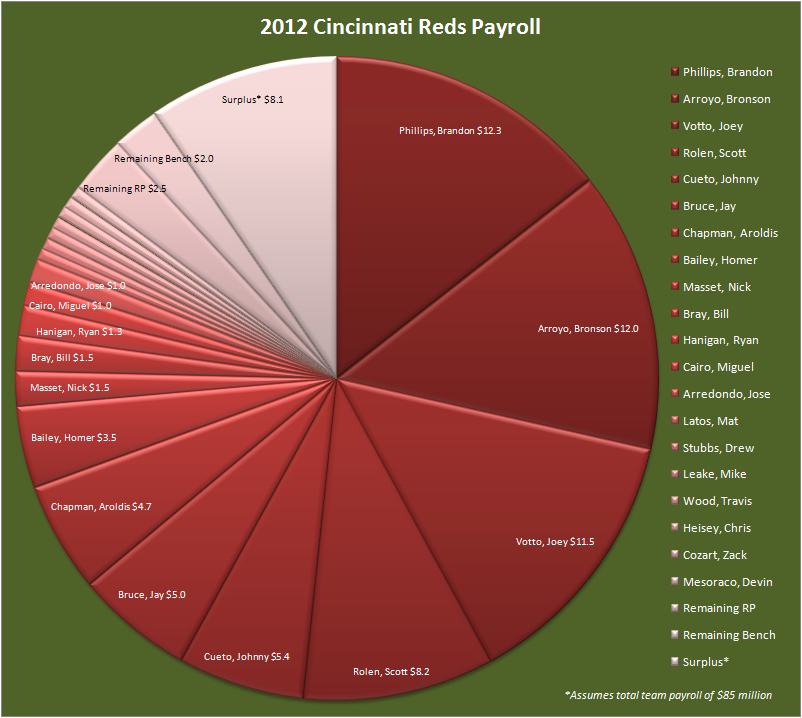
While last week’s payroll pie was awesome and all, there’s no denying that improvements were possible.  Stones left undisturbed.  So, in that vein, I’d like to unveil Reds Payroll Pie 2.0:

2012 Reds Payroll Pie 12-21-11

You’ll immediately notice a few things.  Most importantly, it’s beveled now.

Second most importantly, where uncertainty lay previously, now sits knowledge.  For instance, several players expected to receive significant playing time are up for arbitration.  Without going into excruciating detail about that entire process, suffice it to say that while these contracts are still unknown, one can make educated guesses.  Most notably, Homer Bailey, Nick Masset, and Bill Bray will all earn more than marginal raises.  I have tried to stay conservative with my numbers, but again they are only estimates.

Thirdly, Yonder Alonso and Edinson Volquez are off the books.  It’s hard to notice given all the other changes, but this frees up about three million dollars.

You’ll notice that several pie pieces remain unlabeled.  I decided to delete those off of the main graphic who are expected to play key roles but will be making league minimum (all are estimated at half a million).  Additionally, instead of listing all the additional bench players, or those who may bounce back and forth between Cincinnati and Louisville, I’ve estimated remainder costs for additional reserves and relievers.

Wonderfully, the Reds still have around eight millions dollars of potential surplus (by the way 85 million dollars may be a bit of a ceiling here… somewhere between 80 and 85 is almost assured).  There have been several rumors flying around, including the acquisition of Sean Marshall from the Cubs for around three million.  Also, for some reason Walt Jocketty continues to show interest in Francisco Cordero, with contract speculation coming in at around eight million for one year.  I would be VERY against such a signing, but alas, no one seems to care.

If it were up to me (and others over at Redleg Nation), I would be taking a serious look at Carlos Beltran.

Putting Joey Votto in Perspective

In the early days of this blog, I decided to KISS (keep it simple stupid) and submit a few shorter, more casual posts for general consideration (or at least I tried… you will see that I mostly failed here).  In this one, I would like to do some very quick, very high level analysis of the start of Joey Votto’s promising career.

I’ve already used terms like WAR (wins above replacement) in a previous post, and I apologize if I don’t take the time to explain what it means.  For one, I feel like it implies that I’m an expert which I definitely am not.  Two, sites like Fangraphs or Beyond the Box Score already have fantastic primers on these topics, if you care to learn.  Suffice it to say now that WAR is a quick and easy way to evaluate a player’s season while taking into account lots of different factors (such as baserunning, park factors, other players in the league he’s playing in, etc).  While it is far from perfect, when it comes to using a single stat to evaluate players, it comes in very handy.  Also, think of it as an accumulating stat.  For instance, if Joey Votto tallies 6 wins above replacement in 2011, and 8 wins above replacement in 2010, you can add those together to calculate his total WAR across those two seasons.

Now, with that in mind I am going to utilize a tool on Fangraphs that is legitimately awesome.  Allow me to show you:
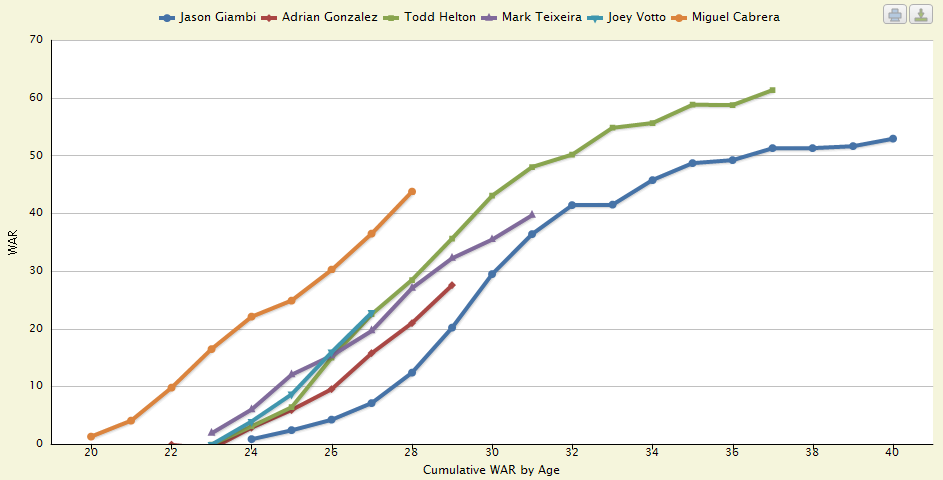
Cumulative WAR by Age

This graph shows cumulative WAR by age for each player.  Using Miguel Cabrera as an example, he earned 1.3 WAR in his first season, at age 20.  At age 21 he gained another 2.8 WAR, netting him a total of 4.1.  Each year in the graph, the player’s additional WAR is added on to his career total.

This type of graph can be used to compare players’ career tracks.  For instance, going back to Cabrera, he clearly had an earlier start than the other players I’ve included (speaking of, I just selected a few high performing first basemen of the last 15 or so years).  While his slope doesn’t appear all that different than Mark Teixeira’s, the fact that he did it about 3 years earlier in career is pretty meaningful.  Most obviously, Cabrera’s head start will give him the opportunity to accumulate more WAR throughout his career.  Secondly, his impressive performances in his early to mid-20s is an indicator of the special player that he is.  It is much easier to find a player who starts in his mid-20s, peaks, and then begins to regress, than it is to find a player who starts producing at a high level in his early to mid-20s (you may notice that Teixeira, while still a very good player, has begun to trail off a bit).

Obviously nothing is a guarantee.  Cabrera, who is battling weight/alcohol issues, could hit a wall at 30, as so many players do.  Teixeira could continue to bounce back a bit.

Getting back to Votto, what is neat about this graph is it provides a visual representation for the start of his career.  Did he get a late start?  Was he in line with his peers?  A few things I notice:

  1. As someone familiar with the Reds, I’ve heard the notion that Votto got a late start, or rather, the Reds kept him in the minors too long (I think Votto himself has danced around this opinion).  However, this graph shows his early career to be no too much different than Teixeira’s or Adrian Gonzalez’s.  On the flipside, you can see that the past 2 years have catapaulted Votto well ahead of those guys after their respective age 27 seasons.  This could be an indicator that had he started playing regularly before age 24, he had it in him to peak a little sooner.
  2. As we’ve already covered, Miguel Cabrera has had a pretty impressive start to his career.  If he can keep himself together he could be a no doubter for the Hall of Fame.*
  3. My selection of players was off the top of my head.  I didn’t include Pujols, because while remarkable, his career path is beyond compare (I recommend adding him in yourself though).  Giambi is an interesting case because of the whole PED issue.  I still thought looking at his curve would be interesting though.  He had his best years around age 30, which is atypical.

*Looking at these graphs reminded me that I’ve read articles around different WAR thresholds and what they mean for a player’s HOF credentials.  I am going strictly off of memory here, but I think 80 WAR is typically a ticket-puncher (unless you’re caught up in the PED business), 70 WAR gives you a pretty good shot, and 60 WAR at least gets you in the conversation.  Again, I could be totally wrong, but I think that’s close.  And of course these are just guidelines and it could differ widely by position, era, etc.

Here’s another graph:
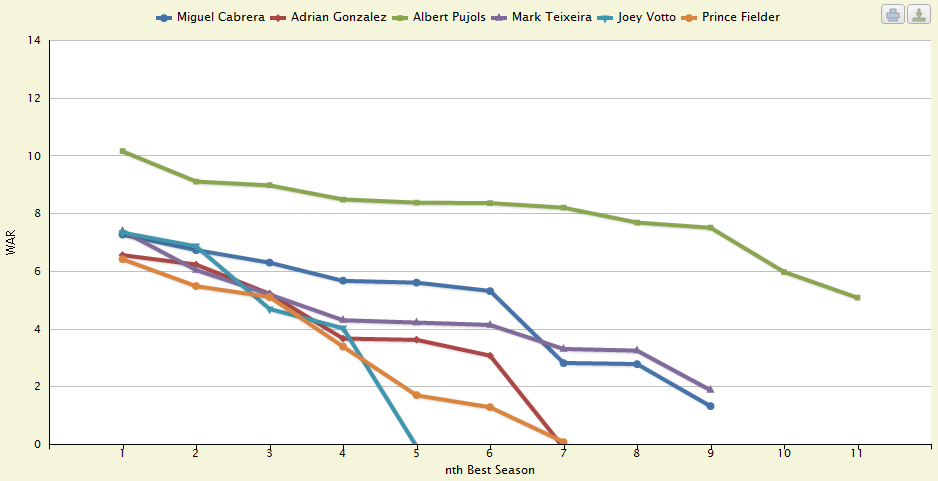
1B Nth Best Season

This one tells a slightly different story (I changed the players around too).  Here, each player’s seasons are ranked from the highest WAR to the lowest, moving from left to right.  For instance, we see that Albert Pujols has turned in a 10+ WAR season.  This graph doesn’t tell us when or how old he was, but that was his best year.  A season that appears to be just over 9 WAR was his second best, and so on.

Votto shows up well here.  Despite having only four full years in the league, his top two seasons match up with anyone’s, save Pujols.  I was a little surprised how close he was with Cabrera.  A couple more seasons like 2010 and 2011 and Votto will be on his way to establishing himself as the clear #2 hitter in baseball.

I will leave you here for now.  The link below will take you to the Fangraphs page… as you can see I added a few players.  It’s a pretty fun tool.

http://www.fangraphs.com/graphsw.aspx?players=547,1744,818,1908,432,1281,4314,1177
Reds Payroll Pie

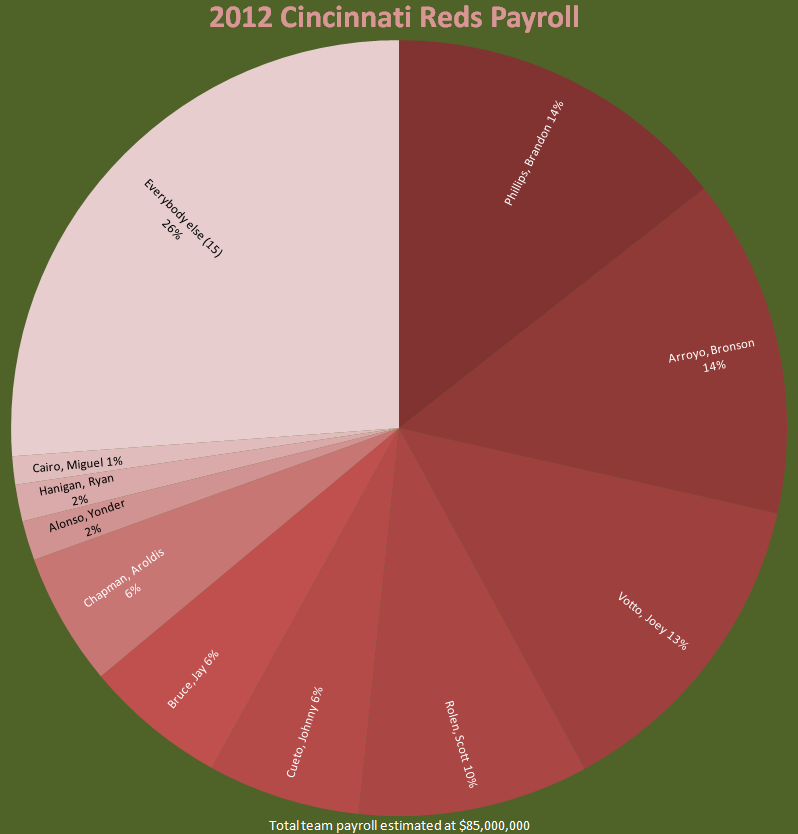
2012 Cincinnati Reds Payroll

This pie chart shows the proportion of Reds payroll that will be going to the 10 guys who already have contracts for 2012 (assuming a total payroll of $85M on opening day).

That’s 4 guys taking 52% of the money.  Judging by 2011, the Reds were half right in that regard… Phillips/Votto accounted for roughly 13 WAR while Bronson Arroyo actually cancelled out Scott Rolen’s 1.3 wins above replacement, resulting in a net of zero for the pair.  Ouch.