Football Thoughts

Happy 2012!  This will probably be a rarity, but I would like to indulge in some football talk:

Bearcats Get 10th Win
First, college.  The Cincinnati Bearcats earned a satisfying bowl victory against the SEC on Saturday.  Yes, it was Vanderbilt, and yes, they were only 6-6, but all of their losses were to SEC opponents, and as we all know, the SEC reigns supreme.  For the seniors, it was their first win in a bowl game.  As exciting as two BCS births were in ’08 and ’09, the Bearcats looked overmatched against Virginia Tech and the Tebow-led Gators.

Offensive stars Isaiah Pead and Zach Collaros played their final games in a Bearcat uniform.  Collaros had an accelerated rehab following an ankle injury in November and struggled.  UC fans will surely give him a pass, however, as he has turned in an exceptional career in Clifton, leading the Bearcats to two Big East Championships, coming within seconds of a National Championship birth, and of course bursting on to the scene as a freshman when Tony Pike got hurt.

Pead of course had a great game, living up to his Big East Offensive Player of the Year status, with 150 yards and a touchdown.  I remember when Pead was a semi-big name high school recruit and bypassed tOSU to come to Cincinnati (I’m pretty sure he’s even from Columbus).  While he was always productive, it took him a few years to live up to the hype and gain the role of “feature back”, but once he did, it was quite a show.  Both will be missed.

Bengals Playing in January
The NFL regular season is over.  I went into the year expecting to hardly pay attention.  I even let the will of Yahoo!’s auto-drafter determine my fantasy roster (I did do a little pre-ranking).  But just when I thought I was out, they pull.. me.. back.. in (sorry).  Two rookie stars and a hot fantasy start forced me to abandon my original plans for autumn Sundays, and 17 weeks later the Bengals have found themselves in the playoffs.

Yesterday on WLW Alan Cutler was discussing how everyone would accuse the Bengals of “backing in” to the playoffs if they got in despite a loss.  I understand that on radio (and TV) everything has to be a story with a headline.  After all, hours of talk radio have to be filled.  Pre-game shows that were once an hour are now three.  But honestly, I think the Bengals’ case was going to be overstated, win or lose.  A win versus the Ravens wouldn’t have meant that they “belonged”.  A loss doesn’t mean that they can’t start clicking and get to the Super Bowl.

Andy Dalton has gotten a lot of hype, but I get a little nervous.  Someone on WLW yesterday (can’t remember who) called him a “franchise quarterback”.  Obviously the term is ambiguous, but I think we are getting a little ahead of ourselves.  Two years ago a rookie quarterback led his team to the AFC Championship.  He was not overly heralded, but he did what needed to be done and let his top 5 defense take care of business.  He even did it again the next year.  And now, I’m pretty sure most Jets fans are tired of waiting for Mark Sanchez to be a “franchise quarterback”.  I’m not saying the situations are the same (after all, do you expect Andy Dalton to be in the AFC Championship game in two weeks?), but let’s just relax for a minute. A.J. Green, on the other hand, will be a star – if he isn’t already.

I honestly don’t care how the Bengals got in.  We’re in.  And history will tell you, sometimes that’s all you need.  (Isn’t if funny… as woe-is-me as Bengals fans like to be, this marks Cincinnati’s second playoff appearance in three years.)

Tebow Rant (it’s short I promise)
I alluded to this already, but it’s not surprising that the media can’t handle Tim Tebow.  First he’s going to be a disaster.  Then he’s winning by divine intervention.  Now he’s regressing.  No, people.  He’s been the same person the whole time.  His “methods” worked for a while (and were probably combining with a significant amount of luck), and now they’re not.  I rooted for the guy.  I even bought into the idea that maybe there was this mysterious “something” that cannot be explained by the most expertiest of expert analysts.  But more and more it appears that the something doesn’t exist after all, and it’s likely that the scene in Denver next week against the Steelers will be a sad one, and perhaps even embarrassing (for the Broncos, their fans, and Tebow sympathizers, that is).

UPDATE: Fixed the paragraph stuff with some suggestions from Zach.
Beltran is a Cardinal

Any seasoned baseball fan should have seen right through all the hype the last couple weeks about the Reds winning the NL Central by default.  Admittedly, I definitely enjoyed the talk.  But alas, one player does not a baseball team make, and while Albert Pujols and Prince Fielder are two of the most impactful players in the game, the Cardinals potentially took a big step toward repeating their 90-win performance last year by signing free agent Carlos Beltran.

Consider: in somewhat of a down year last year, for him at least, Pujols turned in 5.1 WAR.  It was enough for the Cardinals to win 90 games, grab the wildcard, and of course they went on to win the World Series (Pujols did go nuts in the playoffs, slugging .691 in 18 games).  Carlos Beltran had 4.7 WAR last year (not helped by his defense at all either).  In one fell swoop the Cardinals have nearly replaced Pujols’ production at barely more than half the cost!

Alright, so no one honestly thinks Beltran can fill Pujols’ shoes.  But it’s a pretty good start, wouldn’t you say?  And how about the fact that Adam Wainwright didn’t throw a single pitch last year.

Obviously there are many moving parts to any off-season, and adding and subtracting a few players’ WAR doesn’t get you an expected win total.  Additionally, without looking into it I’m going to assume that a few Cardinals outperformed expectations last year, and one could expect some regression next year.  But in a year where Albert Pujols walks, adding Carlson Beltran and Adam Wainwright is a good place to start.

Remember, the Cards and Brewers bettered the Reds by 11 and 17 wins, respectively.  I love the Reds’ off-season moves so far, but I’m not putting them as favorites quite yet.

UPDATE: Of course, over at SB Nation, Rob Neyer has done what I just tried to do, only better.

UPDATED: Reds Payroll Pie

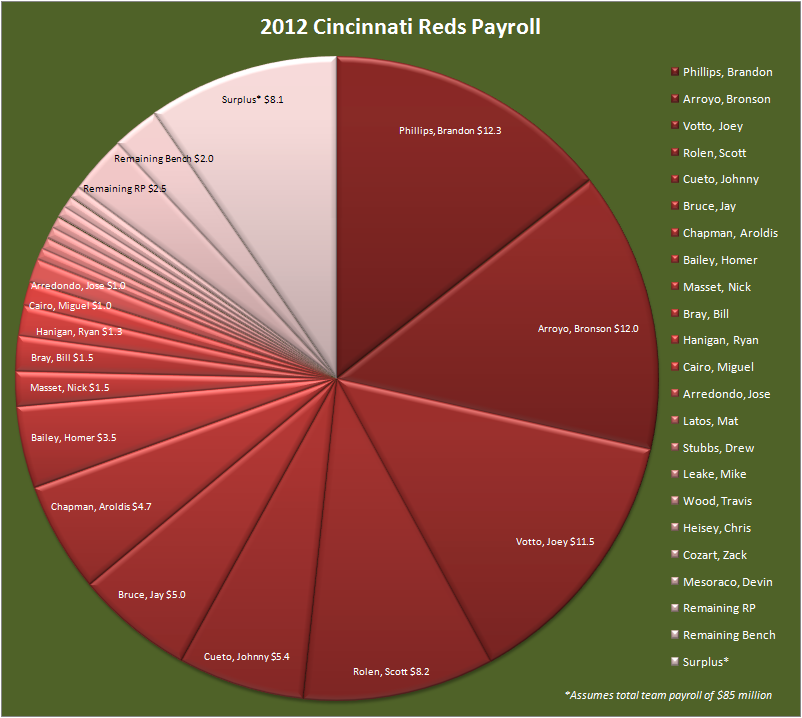
While last week’s payroll pie was awesome and all, there’s no denying that improvements were possible.  Stones left undisturbed.  So, in that vein, I’d like to unveil Reds Payroll Pie 2.0:

2012 Reds Payroll Pie 12-21-11

You’ll immediately notice a few things.  Most importantly, it’s beveled now.

Second most importantly, where uncertainty lay previously, now sits knowledge.  For instance, several players expected to receive significant playing time are up for arbitration.  Without going into excruciating detail about that entire process, suffice it to say that while these contracts are still unknown, one can make educated guesses.  Most notably, Homer Bailey, Nick Masset, and Bill Bray will all earn more than marginal raises.  I have tried to stay conservative with my numbers, but again they are only estimates.

Thirdly, Yonder Alonso and Edinson Volquez are off the books.  It’s hard to notice given all the other changes, but this frees up about three million dollars.

You’ll notice that several pie pieces remain unlabeled.  I decided to delete those off of the main graphic who are expected to play key roles but will be making league minimum (all are estimated at half a million).  Additionally, instead of listing all the additional bench players, or those who may bounce back and forth between Cincinnati and Louisville, I’ve estimated remainder costs for additional reserves and relievers.

Wonderfully, the Reds still have around eight millions dollars of potential surplus (by the way 85 million dollars may be a bit of a ceiling here… somewhere between 80 and 85 is almost assured).  There have been several rumors flying around, including the acquisition of Sean Marshall from the Cubs for around three million.  Also, for some reason Walt Jocketty continues to show interest in Francisco Cordero, with contract speculation coming in at around eight million for one year.  I would be VERY against such a signing, but alas, no one seems to care.

If it were up to me (and others over at Redleg Nation), I would be taking a serious look at Carlos Beltran.

Putting Mat Latos in Perspective

A pretty picture for your perusal:

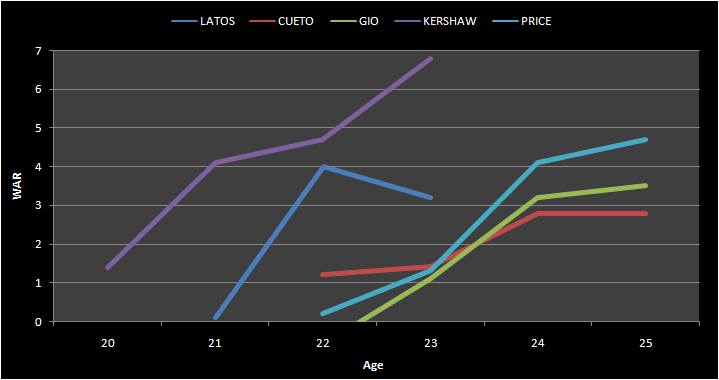
SP WAR Graph WAR by Age

The above chart is WAR by Age (note the colors assigned to each pitcher… I swear I had nothing to do with it… excel really is that smart).  The players included were selected for various reasons.  I mostly wanted to take the Reds new “ace” and compare him to: the incumbent, the one that wasn’t, the pipe dream, and the National League’s 23-year-old Cy Young winner.

To me, the most notable characteristic here is the grouping of Johnny Cueto, Gio Gonzalez, and David Price.  “Grouping” is used loosely here as no one would really equate those three.  Cueto had a faster start though has leveled off, and surely did not have the credentials to match Price’s coming out of the minors.  Gio had a slightly slower start though is coming on strong and may have marginally better peripherals than Cueto.

Then we have the other two.  Kershaw was included mostly as a comparison point.  I don’t think anyone can expect that type of performance from a pitcher in his early 20s.  It’s pretty impressive.  And then in the middle there’s Latos.  Clearly he had an earlier start than the first three, though his peak seasons don’t quite match what Price has done in each of the last two years, and unlike every other guy his this chart, he actually trended downward last year (honestly, though, I think it speaks to the quality of the pitchers shown that only one has a negative slope at any point… most players will experience this at some point).

There’s a perfectly good explanation for this that isn’t exactly top secret.  In 2010, Latos’ first full season, the Padres unexpectedly found themselves in the middle of playoff contention.  Where they had originally planned on limiting Latos to around 150 innings (rather standard for a youngster’s transition year into the majors) they instead relied on him down the stretch and he ended up eclipsing 180 IP.  He tired late in the year and experienced shoulder soreness which carried over into 2011.  He started 2011 on the disable list and struggled when he returned, opening the year 0-5.  However, as documented in the links provided yesterday, he bounced back considerably (partly due, it is believed, to his increased use of his slider, often referred to as his “out” pitch) and still turned in a VERY nice year for a 23-year-old.

The injury is slightly troubling, as nagging shoulder soreness can really put a damper on a promising young pitching career (Cueto and Chapman have had similar issues).  But Latos’ performance toward the end of 2011 is encouraging.

As much as I like to look at these numbers, it’s easy to get lost in them, overanalyze, and think that you have it all figured out.  There’s no predicting where each player’s WAR will end up next year.  But you have to be encouraged by Latos’ ahead-of-the-curve-edness.  Given the fact that many Reds fans had put a lot of focus toward Gio, and that Price was viewed as ideal but unrealistic, it can be interesting to see how the numbers really play out.  While All-Star caliber pitchers can get their starts at any age, we shouldn’t completely discount the fact that Latos is two years ahead of the other three.  It leaves a lot of room for growth, and the Reds have four years to watch it play out.

We Got Mat Latos, You Guys

On Saturday the Reds traded away Edinson Volquez and prospects Yonder Alonso, Yasmani Grandal, and Brad Boxberger to the San Diego Padres for starting pitcher Mat Latos.  The potential deal Reds fans have been hearing about all off-season is finally here.  Now, what to make of it?

I’ve now read numerous takes on the deal and the general consensus is: Reds gave up a lot; Latos could be very good.

These seem somewhat conflicting, which has been slightly frustrating for this Reds fan.  Though I may also point out, this is the biggest trade my team has been a part of since I’ve been fully plugged into the world of twitter and various other fast-paced media.  Because of this, I imagine that there are more opinions than ever, and added incentive to stand out and be noticed.  Therefore it is our job, as consumers of this media, to wade through it all and make some sense of it.

First, Mat Latos.  Redleg Nation, the Reds representative in ESPN’s SweetSpot Network, has put together a “Meet Mat Latos” post.  It does a very thorough job profiling his career to this point.  Of note: Latos will only be 24 next year, and has 4 years of team control remaining (if you have questions about what this means, the RN post includes a primer on arbitration and what happens to a player before he hits free agency).

Latos is not without risk.  I’ve read things about his injury history and his makeup.  Latos tired down the stretch in 2010 and started 2011 on the disabled list.  However, as the RN post notes, he bounced back in the second half.  One would hope that his big frame leaves him less susceptible to injury than the average pitcher.  I haven’t read too many specifics on the personality concerns, other than a possible lack of maturity when he gets behind in the game.  He also appears to have a large number of tattoos.

Obviously any pitcher has the potential to flame out.  However, Fangraphs founder Dave Cameron gives his take here, where he is high on Latos and the Reds’ move.  There is a table near the top that groups Latos in with a pretty impressive bunch.  His peripherals (which generally refers to K rates, BB rates, and HR rates) are top notch, which bodes well for his move from “cavernous” Petco Park to the GABP.  As has been noted numerous places, his HR rate was actually higher at Petco than it was on the road, and the ERA and FIP differences are marginal (FIP refers to Fielding Independent Pitching, which attempts to eliminate factors that are beyond the pitcher’s control from the evaluation of his performance).  As this article from Fangraphs’ fantasy baseball-minded arm points out, pitching in various away ballparks and pitching every home game at GABP is not the same thing.  However, I think Latos gives us as much reason as possible to be optimistic about the transition.

Keith Law, ESPN’s prospect guru and unrestrained king of snark, also likes the deal (sorry, Insiders only).  He opens with:

The Cincinnati Reds give up a lot of future value, but nearly all of it surplus value for their club, in exchange for a legitimate front-of-the-rotation starter. The San Diego Padres swap quality for quantity in a building move that helps them but doesn’t entirely add up for me.

He notes what those outside the situation seem to be reticent to admit: that while 4 players seem like a lot, each isn’t without limitation.  To me, Alonso is the surest bet to contribute significantly, as he’s had successful major league experience.  However, he is not likely to match his 2010 performance moving forward, and in my opinion the Reds did exactly what they should have done (given an Alonso deal was to be done) and struck while the iron was hot.  Grandal probably has the highest ceiling of the group, but he is still a year or two away, and there are question marks about his defense and whether he can continue catching.

The most negative comments made on the trade came from Buster Olney’s twitter feed:

First rival evaluator I spoke with LOVES the trade for the Padres: “San Diego made an absolute killing with that deal.”

E-mail from second rival evaluator (and don’t kill the messenger): “Overall big win for Padres and huge gamble for Reds.”

Observation of third rival evaluator: “The only way I’m making that trade for Latos is if he has [perfect] mound makeup. And he doesn’t.”

4th scout on Latos deal: Possible strong No. 2 starter, with significant risk. This evaluator says CIN gave up 3 of their top 5 prospects.

More of an FYI than anything else… depends on how much you trust the POV of talent scouts.  However, 3 out of top 5 prospects is a bit of a stretch.  According to Baseball America the trio was #3, #4, and #10 in the organization.  Also feel free to check out SB Nation for a slightly negative slant on the move, including Rob Neyer’s non-endorsement (which makes me sad).

In conclusion, I will leave you with this: yesterday I was thinking through what I wanted to write in a Mat Latos piece.  Well, when I read this Redleg Nation post I realized I was too late.  It gives an excellent overview for what the trade could mean for the upcoming season.  (By the way, I highly recommend RN for any Reds fan.)

I would like to follow this up with a deeper look at some of the numbers, so be on the lookout in the next several days.

Putting Joey Votto in Perspective

In the early days of this blog, I decided to KISS (keep it simple stupid) and submit a few shorter, more casual posts for general consideration (or at least I tried… you will see that I mostly failed here).  In this one, I would like to do some very quick, very high level analysis of the start of Joey Votto’s promising career.

I’ve already used terms like WAR (wins above replacement) in a previous post, and I apologize if I don’t take the time to explain what it means.  For one, I feel like it implies that I’m an expert which I definitely am not.  Two, sites like Fangraphs or Beyond the Box Score already have fantastic primers on these topics, if you care to learn.  Suffice it to say now that WAR is a quick and easy way to evaluate a player’s season while taking into account lots of different factors (such as baserunning, park factors, other players in the league he’s playing in, etc).  While it is far from perfect, when it comes to using a single stat to evaluate players, it comes in very handy.  Also, think of it as an accumulating stat.  For instance, if Joey Votto tallies 6 wins above replacement in 2011, and 8 wins above replacement in 2010, you can add those together to calculate his total WAR across those two seasons.

Now, with that in mind I am going to utilize a tool on Fangraphs that is legitimately awesome.  Allow me to show you:

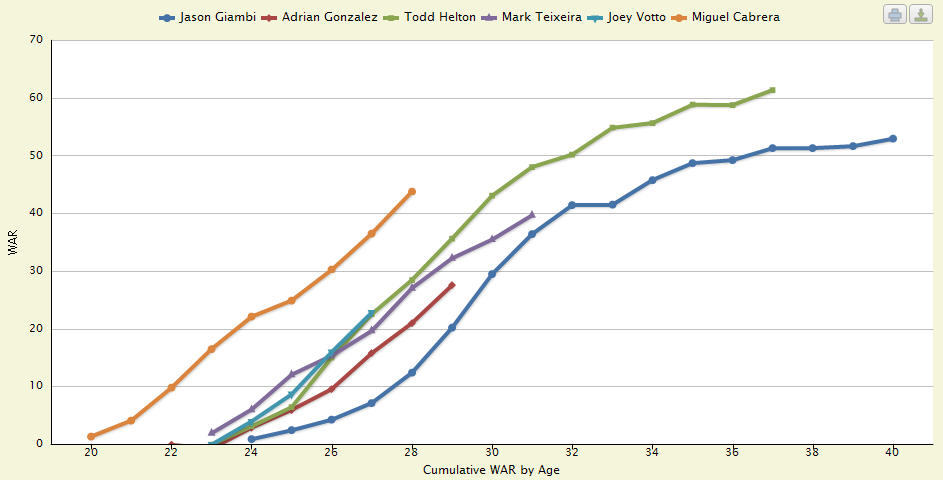
Cumulative WAR by Age

This graph shows cumulative WAR by age for each player.  Using Miguel Cabrera as an example, he earned 1.3 WAR in his first season, at age 20.  At age 21 he gained another 2.8 WAR, netting him a total of 4.1.  Each year in the graph, the player’s additional WAR is added on to his career total.

This type of graph can be used to compare players’ career tracks.  For instance, going back to Cabrera, he clearly had an earlier start than the other players I’ve included (speaking of, I just selected a few high performing first basemen of the last 15 or so years).  While his slope doesn’t appear all that different than Mark Teixeira’s, the fact that he did it about 3 years earlier in career is pretty meaningful.  Most obviously, Cabrera’s head start will give him the opportunity to accumulate more WAR throughout his career.  Secondly, his impressive performances in his early to mid-20s is an indicator of the special player that he is.  It is much easier to find a player who starts in his mid-20s, peaks, and then begins to regress, than it is to find a player who starts producing at a high level in his early to mid-20s (you may notice that Teixeira, while still a very good player, has begun to trail off a bit).

Obviously nothing is a guarantee.  Cabrera, who is battling weight/alcohol issues, could hit a wall at 30, as so many players do.  Teixeira could continue to bounce back a bit.

Getting back to Votto, what is neat about this graph is it provides a visual representation for the start of his career.  Did he get a late start?  Was he in line with his peers?  A few things I notice:

  1. As someone familiar with the Reds, I’ve heard the notion that Votto got a late start, or rather, the Reds kept him in the minors too long (I think Votto himself has danced around this opinion).  However, this graph shows his early career to be no too much different than Teixeira’s or Adrian Gonzalez’s.  On the flipside, you can see that the past 2 years have catapaulted Votto well ahead of those guys after their respective age 27 seasons.  This could be an indicator that had he started playing regularly before age 24, he had it in him to peak a little sooner.
  2. As we’ve already covered, Miguel Cabrera has had a pretty impressive start to his career.  If he can keep himself together he could be a no doubter for the Hall of Fame.*
  3. My selection of players was off the top of my head.  I didn’t include Pujols, because while remarkable, his career path is beyond compare (I recommend adding him in yourself though).  Giambi is an interesting case because of the whole PED issue.  I still thought looking at his curve would be interesting though.  He had his best years around age 30, which is atypical.

*Looking at these graphs reminded me that I’ve read articles around different WAR thresholds and what they mean for a player’s HOF credentials.  I am going strictly off of memory here, but I think 80 WAR is typically a ticket-puncher (unless you’re caught up in the PED business), 70 WAR gives you a pretty good shot, and 60 WAR at least gets you in the conversation.  Again, I could be totally wrong, but I think that’s close.  And of course these are just guidelines and it could differ widely by position, era, etc.

Here’s another graph:

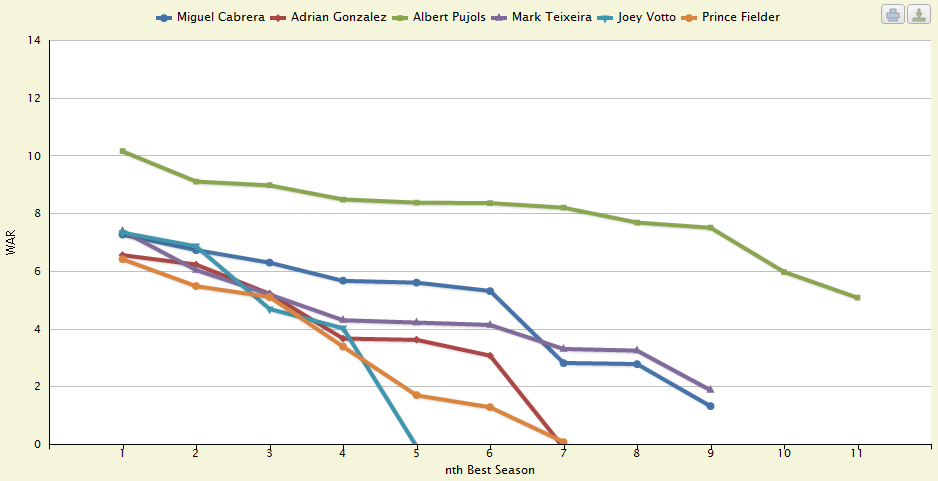
1B Nth Best Season

This one tells a slightly different story (I changed the players around too).  Here, each player’s seasons are ranked from the highest WAR to the lowest, moving from left to right.  For instance, we see that Albert Pujols has turned in a 10+ WAR season.  This graph doesn’t tell us when or how old he was, but that was his best year.  A season that appears to be just over 9 WAR was his second best, and so on.

Votto shows up well here.  Despite having only four full years in the league, his top two seasons match up with anyone’s, save Pujols.  I was a little surprised how close he was with Cabrera.  A couple more seasons like 2010 and 2011 and Votto will be on his way to establishing himself as the clear #2 hitter in baseball.

I will leave you here for now.  The link below will take you to the Fangraphs page… as you can see I added a few players.  It’s a pretty fun tool.

http://www.fangraphs.com/graphsw.aspx?players=547,1744,818,1908,432,1281,4314,1177

Reds Payroll Pie

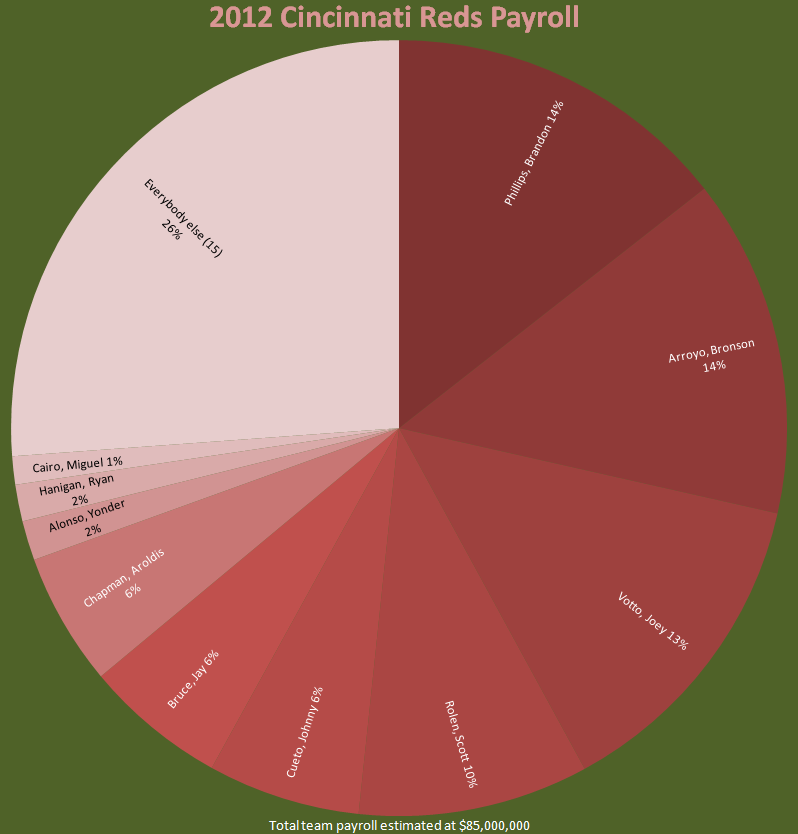
2012 Cincinnati Reds Payroll

This pie chart shows the proportion of Reds payroll that will be going to the 10 guys who already have contracts for 2012 (assuming a total payroll of $85M on opening day).

That’s 4 guys taking 52% of the money.  Judging by 2011, the Reds were half right in that regard… Phillips/Votto accounted for roughly 13 WAR while Bronson Arroyo actually cancelled out Scott Rolen’s 1.3 wins above replacement, resulting in a net of zero for the pair.  Ouch.

God Shows Mercy on NL Central, Smites Astros

In a stunning turn of events, slugging first baseman Albert Pujols is headed to Anaheim.  Fans in Chicago, Cincinnati, Milwaukee and Pittsburgh rejoice.  Fans in Houston?  Well, they get to look forward to at least 9 more years of the guy after their impending move to the AL West is complete.

The good news?  By the time the Astros are relevant again, Pujols will likely be in his late 30s, and his production may be slightly below its current super-human level.