Baseball Movie #2: Catching Hell

For my second movie, I started already chipping away at my documentary limit, but it was worth it. For a while now, Jayne and I have been wanting to watch Catching Hell, about the Steve Bartman incident and scapegoating. We are both fans of the 30 for 30 series on ESPN. The first one we ever saw was the one about the death penalty on the SMU football program. It must be good because I have no interest in SMU football and Jayne certainly doesn’t.

So I figured if we’re going to spend a disc it would be on a movie that Jayne would watch too. I think Catching Hell did its job because Jayne seemed really into it. The movie did a great job of conveying the living nightmare Bartman must have gone through with the entire stadium chanting “Asshole” at him.

The story of Bartman is fascinating because he is someone who did not want to capitalize or respond to the situation. The stories of him turning down six figure amounts for card shows or $25,000 to sign a picture of himself are pretty amazing. I mean if I went through that crap I’d be tempted to harvest it some.

Like most decently done documentaries, the score is a cakewalk. It’s hard to strike out with me if you’re a documentary. The only strikeout for this movie was when it tried to reach a little further and make further scapegoat connections including a minister who gave some sort of sermon on Steve Bartman and scapegoating. I understand the stress a minister must have of coming up with a topic every week but her story seemed pretty fluffy and not really needed for the movie.

Catching Hell – 3 for 4, strikeout, two singles and a homerun

As you’re probably aware this scoring system is already pretty weak. I’ll just say this was a good movie. It made me feel for Bartman and made me want the Cubs to win a World Series for him but to never win a World Series for the rest of the fans. The homerun was definitely for the selection of the topic. It was a great choice to get the ESPN Films treatment.

Fantasy Baseball Valuations, Pt. 1

I realize that this topic will not interest everyone, and in fact may be the most limiting thing I’ve written about so far when it comes to audience appeal.  I’m going to go ahead and apologize now because this is fairly self-indulgent, and very nerdy.  I’m also going to apologize to Zach for plopping this down right in between his movie month intro and the subsequent followups.  However, this has just been on the forefront of my mind, and I have confidence Zach and his wonderful idea will rebound.

I have been playing fantasy baseball since college, and my involvement has gone through several stages.  I don’t really remember my first fantasy baseball league, but I’m going to assume I was pretty pumped about the idea of being in charge of my own team, drafting players and setting lineups.  I’m pretty sure these are the same reasons most people get into it.  And as most serious fantasy baseball participants soon discover, some of our favorite aspects of the game aren’t fully captured in your most basic fantasy league: setting the batting order, evaluating prospects, deciding how much value a player loses when he undergoes Tommy John surgery.  So of course, we search for more.

I don’t really remember the first time I joined a keeper league, but I’m going to assume it was pretty soon after I joined a non-keeper league and realized how much awesomer keeper leagues sounded.  And it didn’t take long until even that didn’t satisfy me.  I wanted to build a roster, contemplate middle relievers, and not have every guy in my starting lineup bash 20+ homeruns.  So I did the only logical thing and joined a 30-team sim league.

I’m going to pump the breaks a little here.  I don’t want to get too far into this, partly because my apology at the beginning of this post would be a severely sub-sufficient warning for what would transpire.  I will say that I spent hours and hours looking at every major league player’s three previous years of stats, ranking every position.  And by the way, this is weird to think, but I’m realizing as I type this that it doesn’t sound as crazy now as it would have in 2003 when I was doing it.  I won’t speak definitively on the nature of the universe of baseball stats and analysis, but at least to me, it was nothing like it is now.  No Fangraphs, no exportable stats, no easy and convenient way to get everything in one place.  I remember I spent one summer vacation pouring over pages and pages of printouts, taken from ESPN’s stats pages and sloppily copied and pasted into Excel.

But anyhow, hopefully some of your faith in me is restored when I tell you it didn’t take much more than a season for me to determine that it wasn’t sustainable.  Perhaps the realization that I was in college and shouldn’t spend hours alone in my room played a part, I dunno.  But let’s get back to the point.

The point is, despite the ups and downs, I would never lose the desire to build my own successful baseball team.  Generally speaking, my fantasy baseball involvement has leveled off somewhat to a place I’m comfortable with.  Specifically speaking, Fangraphs introduced a fantasy game last year with stat categories deviating from the norm, and that’s sort where all this starts.

For a while now I’ve had this end-goal in mind when it came to evaluating players for fantasy.  Yes there are tons of rankings out there, and even some that give you auction values and yada, yada, yada.  But honestly, I’ve wondered where those came from.  How do they come up with a dollar value for what a player is worth.  Any maybe it’s not such a difficult question on an abstract basis, but if I literally wanted to start writing formulas and crunching numbers, how would I do it.  This became even more necessary when I joined a Fangraphs league, because most rankings out there consider stolen bases and wins, and those were stats I needed to completely ignore.  What had been a dream was going to have to become reality: I needed to develop my own system for valuing players.

Whenever I had attempted to tackle this topic, my idea had typically centered around the idea that every run, every homerun, has a dollar value, and as a player accumulates these stats, he accumulates value.  For counting stats this is somewhat simple.  How many homeruns are hit in the National League?  How much money do you have to spend?  Some quick division and you have a dollar value per homerun hit.  Obviously there’s a lot more to go through but the general idea is there.

Rate stats threw a wrench in it all.  Players don’t accumulate on base percentage.  How do you give a dollar value to a percentage point of OBP?  And really, more importantly, you can’t just consider pure OBP because it doesn’t account for playing time.  A starter with an OBP of .360 obviously has more value than a bench player with an OBP of .360.  Additionally, a player with a .220 batting average doesn’t add value.  Logically speaking, there is a point at which a player’s batting average is low enough that it hurts his value.  And if you think about it, this is true for counting stats as well, though I didn’t realize it at first.  When Juan Pierre is on your team, he generally helps in stolen bases and average (stick with me here, I know he’s old).  But his homerun and RBI totals are deficits to your team, and it all contributes to the net value that he provides.  I realized that instead of benchmarking every player at zero, the benchmark should really be a league average, and to the extent a player is above or below that average in a given stat category, he adds or subtracts value.

What I would like to do now is show you what I’ve started doing, and then reveal an interesting result that came out of my league.  Like I said before, this is somewhat self-indulgent, but I also see it as documentation, as well as an opportunity to share some knowledge/ideas to whomever wishes to consume it.  Finally, if you see anything that doesn’t make sense, or you want to yell at me about how much of an idiot I am, I welcome that too.

First I will tell you that this Fangraphs league includes runs, homeruns, on base percentage, and slugging percentage for offensive players.  There are 12 teams in the league, with each team allowed 40 roster spots and $400 dollars to spend.  Let’s start with runs and homeruns.

Actually, let’s stop here to remind ourselves that there must be several assumptions that go into a process like this.  The first, and possibly most important, is the data source.  I am trying to predict 2012 value, so I need 2012 stats.  The obvious problem here is that there aren’t any yet.  So of course I go to trusty ol’ Fangraphs who generously provides us with projected 2012 stats thanks to RotoChamp.

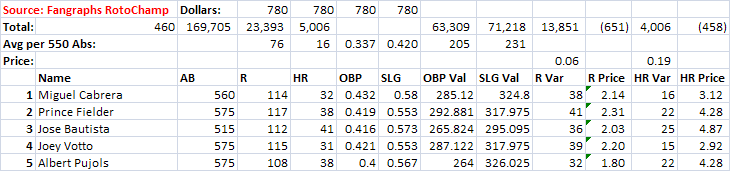
With that out of the way, let’s say we want to determine how many dollars Prince Fielder’s league-leading 117 runs are worth.  As I mentioned before, you might first decide that the place to start is determine how much a single run is worth.  However, we can’t simply look at a single run out of context.  If Prince Fielder were to score 1 run the entire year, he would actually provide negative value.  Instead, we need to compare his aggregated total to that of the average player.  To do this, I introduced our second assumption, which is that the average number of at bats for a typical major league starter is around 550.  I honestly don’t have a lot backing that up.  I mostly based it off of the idea that 600 AB is a full season, and then I wanted to account for routine off days, minor injuries within our pool of players, etc.  (I might also argue that what this exercise is really doing is calculating relativities, so the exact number I picked here doesn’t really matter much.)

Ok, so what we’re left with to compute the average number of runs is:

  1. Take the total number of runs for the entire league (23,393)
  2. Divide it by the total number of at bats for the entire league (169,705)
  3. Multiply by 550 to get 76 runs (all numbers from RotoChamp projections)

This is the average for the league.  Clearly, Fielder is projected to be above average for this particular category, while other players will be only slightly above average, and still others below average.  So, instead of assigning a value to the run itself, we are going to assign a value for every run above or below the average.  The first step then, is to determine how many above average and below average runs there are.  I do this by taking the absolute value of each player’s total runs minus the average (in Fielder’s case the result would be 41).

Next, sum up number of runs above and below the mean (13,851).  And finally, we can assign a value, which brings us to assumption #3.  I mentioned before that each team has $400 to spend, which results in a league-wide total of $4800.  Since there are 4 hitting and 4 pitching categories, we could just divide $4800 by 8.  Problem is, that is essentially stating that a fantasy player should spend the same amount on hitting that he does on pitching, which probably isn’t the case (I sort of file this idea under “fantasy rules that are mostly assumed”, but I believe the reasoning is that pitching is much less reliable/predictable… there are probably other reasons too).

So what I wanted to do was determine a split between hitting and pitching dollars.  I did this by taking ESPN’s auction values from last year and calculating how much they allocated to hitters and pitchers, respectively.  This resulted in about a 65/35 split between hitting and pitching, so I divided the league’s dollars accordingly: $3120 for offense, $1680 for pitching.  Now, I think you can argue that each category within hitting and pitching are worth the same (I can’t think of any reason why they wouldn’t be) so I divided each number by 4 to get a dollar amount per category.

Back to runs.  We’ve now determined that there are 13,851 runs above or below the average, and that $780 league dollars will be spent on the category.  Some simple division (780 / 13,851) tells us that each marginal run is worth 5.6 cents (we’re almost there I promise).  Now multiply 0.056 times each player’s number of runs above or below the average, and you get a dollar value for that player’s run stat (be sure you use the actual difference this time instead of the absolute value because we want to reflect players who contribute negative value due to their low run totals).  For Prince Fielder, we get 0.056 * 41 = $2.31.  You will see later that there are actually a few more league-wide adjustments to make based on roster size and total league dollars, but for now our run component is done.

This same process is done for all counting stats.  I included a portion of my spreadsheet below to provide a visual.  In part 2 I’ll cover how to adjust the calculation for rate stats, and how we come up with final dollar values.  Thanks for reading.
Baseball Movie #1: The Final Season

I wanted to kick off Baseball Movie Month with a movie that’s been on my list for a while. It’s not been on there because I anticipated it being awesome but it was one of those “I have to see it”s because it is based on a true story from Iowa and was shot entirely in Iowa. In fact, several scenes were shot down the road from my folks’ place along a road I drove down twice everyday for three years. It’s no Hollywood blockbuster but it’s cool to see things you know in the pictures.

Barn with the sign on Sutliff Road

Cedar View Farms

Sutliff Bridge - This is no longer there thanks to the flood of '08. Bonus Iowa law reference

That said, this movie was terrible. Baseball movies are bad, I think. One thing I typically hate is the action in baseball movies but this was actually The Final Season‘s strong suit. I felt like the action was more realistic and interesting. In fact, sadly, probably my favorite part of the entire movie was a montage of the team taking infield. It was beautiful. So there you have it, the rest of this movie was worse than watching a team take infield.

The rest of the movie was a huge cliche. I feel like I’m more sensitive to cliches but this one was way over the top. Just about every line of dialogue was just cliche responding to cliche. There’s a scene where Tom Arnold argues with his son about smoking and it has everything. The crumpling up of the remaining cigarettes, the “Mom did it too”, the “these things killed your mother”, the “your high stress job and lack of fathering has led me to these cigarettes.” This was all in like one minute.

The only other good thing I can say about this movie is it is the first one I’m reviewing which gives me the chance to unveil my scoring system.

Final Season, The – 1 for 3, walk, infield single

The walk was a gimme. The movie took place in Iowa and had shots of places I knew. The movie gracefully took this walk and while simplifying Iowans somewhat it was quite true to the look/feel of rural Iowa.

The infield single is really another gimme. But, I might say this is the best baseball action I’ve seen in a movie. What kept that dribbler fair down the 3rd base line was Rachael Leigh Cook. I guess I really haven’t thought about her since high school but she was a good bonus to keep me going through a shitty movie. I’m not saying she was spectacular and my reasoning’s pretty basic and patronizing but she looked cute in a baseball glove.

Up next: Mr. Baseball most likely.

Baseball Movie Month

Ever since last year’s MLB season ended I’ve been trying to think of a way to ease the pain. My wife says I’m always looking for the next fix. She’s even said I’m this close to hanging out at parks asking, “You sure you kids don’t want to just play some baseball so I can watch?”

Last November I thought maybe I’d have an off-season baseball movie month but we were in the middle of a move back to Iowa so I delayed my plans. I ultimately settled on February for a few reasons. There’s not much baseball going on and it would be a good lead in to the college baseball season and spring training. Also, my experience with baseball movies is they tend to suck, so I should probably start with the shortest month. I don’t want to try my wife’s patience any further.

So that’s what I’m going to do here. I thought I’d lay down some ground rules/expectations. First, I’m going to try for 29 movies. I’m really going to try for a movie a day but as nice as the weather’s been maybe someone will show up and ask me to play some pickup baseball one day and I’ll have to watch two movies the next. One can dream right?

I have a list of movies to pick from and I’ll try to post a more official list soon but for now the focus is going to be on movies that I’ve wanted to see/should see. I will probably mix in some novelty movies. I have actually not seen a ton of baseball movies so there are some classics that will be on the list. I’ve never seen The Natural or Bull Durham and I’ve only seen movies like Field of Dreams and Eight Men Out when I was really young. Oh and I haven’t seen Ed, we can’t forget Ed.

I’m going to lean towards fiction. Documentaries are easier movies for me to pick. I have a documentary about origami in my Netflix queue for Pete’s sake. So I’m going to set a 50% limit on documentaries. I will try to even include biopic-type fare in that count like The Babe.

The most important ground rule is that I will lean towards movies that interest Jayne. I’m guessing that’s about three films, tops. There are several good choices on Netflix Instant so I don’t have to “spend” a disc on a baseball movie. The ones that are “important” will warrant a spent disc occasionally. For example, as a baseball fan in Iowa, The Final Season is required viewing. I’m expecting it to be pretty weak but we’ll recognize places plus Samwise!

In fact The Final Season is the first one to arrive tomorrow. We’ll let that one get us started, I’ll probably have some more ground rules, a more finalized list and a scoring system to come. Obviously I wouldn’t be telling you about this if I wasn’t going to keep you posted on each movie. Pitchers and catchers report tomorrow for The Final Season.

Another look at contracts

On Wednesday I submitted a map that attempted to show the highest total value contracts in Major League Baseball history.  Predictably, New York was pretty crowded, but overall it played out well.

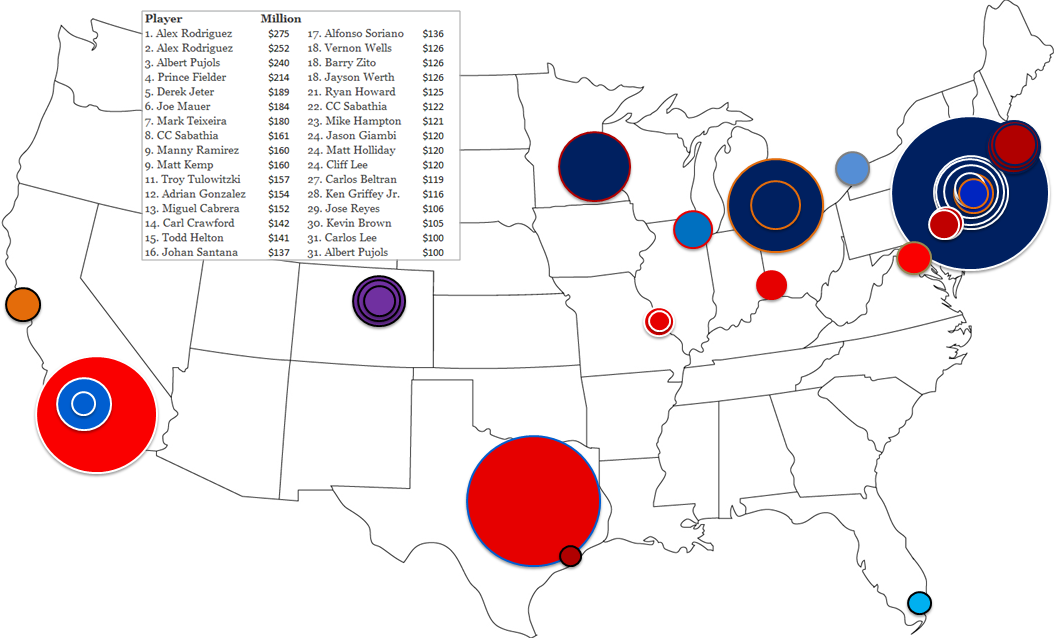
Yesterday, Twitter acquaintance Joel Luckhaupt (@jluckhaupt) wondered aloud what a map using the highest annual average contracts would look like, so I thought I’d find out:

Avg Ann Contract Value Map

Compare to previous map, if you like.

Some new teams are represented (Seattle, Milwaukee), though more were eliminated, which makes some sense considering dollars per season is a little more difficult for the mid and small market teams to get in on.  Overall it looks fairly similar in most cases, with the northeast getting even more attention.  There is less differentiation between bubble sizes this time around since we were working within a range of $18 – $28 million instead of $100 – $275 million.  Also kind of forgot about those one-year Clemens contracts.  Funny.

An enjoyable and enlightening process, again.

Filling out the roster…

I joined Twitter over two years ago almost as an afterthought.  I had dabbled with blogs a bit, but I wondered if this might be a better outlet for times when I wanted to write things that were mostly only important to me, but could be important to others, if only they were given a chance to read them.  Well, like with most things, you only get out of it what you put in, and I didn’t really put anything in.  I didn’t have much use for Twitter, most of my friends weren’t on Twitter, so things I wrote really weren’t getting to anyone.

In any case, in what seems like WAYYYY longer than the two years since, Twitter, at least for me, has exploded into the primary source for sporting news.*  I feel I’m not alone here.  Rob Neyer just wrote a delightfully creative post on the Prince Fielder signing according to Twitter.  I don’t think my Twitter feed is quite as active as Rob’s, which is somewhat by design.  Though I check it more now than I did several months ago, I felt that following too many people would be counterproductive.  When checking on an irregular basis, tweets from people I was really interested in would get lost in the sea of tweets from people I was only moderately interested in.  So, I chose who to follow with precise deliberation.  Among the shoo-ins were sources like Neyer, Posnanski, Fangraphs, Redleg Nation, etc.

*I don’t know if it was like this for other people before it was like this for me, but I do think the way Twitter is used now is a phenomenon that has developed in around the past two years, -ish.

Quickly, though, I realized that my horizons could be broadened by carefully selecting accounts slightly outside my comfort zone.  One of the first of these was Royals Authority, an intelligent baseball source with the right amount of snark and humor.  My roommate at the time was a Royals fan, and we all know that some of my favorite baseball people have connections to Kansas City, so it seemed to fit.  Another, was Bill Baer from Crashburn Alley, a Philly fan whose name I’d heard multiple times as I dug deeper into the world of internet baseball literature.

That was a really roundabout way of telling you that Bill posted something interesting yesterday, which prompted this interesting response four hours later, that Bill then retweeted…

Crashburn Alley Tweet

I couldn’t help but agree wholeheartedly with Miles Musselman.  And one of the reasons it is such a great name, in my opinion, is because it clearly is in reference to something somewhat obscure, and not in that, I know something you don’t and I’m going to rub it in your face kind of way, but in a, I bet that’s a really cool baseball story and I want to be a part of it, way.

So of course I went to Bill’s original tweet and clicked on his link, which took me to this, a reaction to the transaction from earlier this week that sent 26-year-old lefty reliever Jeremy Horst to the Phillies in exchange for utility infielder Wilson Valdez.  All those descriptors in front of those two names might indicate that this was a relatively minor move, and in most respects it is.  But when it comes to internet baseball literature, nothing is minor.

If you’ve made it this far, you clearly have all the time in the world to read any such thing you stumble upon in the internets, so I’ll go ahead and let you read the post yourself, which is quite interesting and goes into detail about the Reds’ newest acquisition (and this particular Philly fan’s opinion of him).  It doesn’t get me all that excited about the move, to be honest.  However, we are finally to the point where the title of this post actually makes sense.

This week saw the Reds take several steps toward filling out the 2012 roster.  One was getting a couple utility guys in Valdez and Willie Harris.  Personally, I understand the need for depth, though I’m not crazy about either.  I do admit that I haven’t taken the time to look into either guy.

The Reds also settled matters with a couple arbitration eligible players, Nick Masset and Jose Arredondo.  This gave me a great idea: let’s go back and take a look at the pie to see if my salary guesstimates were anywhere close on the arb guys.

Player – Aaron’s 2012 Salary Guess – Actual 2012 Salary
Homer Bailey – 3.5 – 2.425
Nick Masset – 1.5 – 2.5 (part of a 2 year deal)
Bill Bray – 1.5 – 1.4175
Paul Janish – 0.5 – 0.85
Jose Arredondo – 1.0 – 1.0

I’m going to go ahead and say it – I did ok.  In the Payroll Pie article I admitted that I tried to stay conservative, which played out with Bailey.  He’s been inconsistent as a Red, and it showed in his first year of arbitration eligibility.

For Masset, I think (1) I put less value on relievers than the average baseball team, and (2) I probably got a little caught up in some of the anti-Masset clamoring that goes on in the comments of Redleg Nation, when in reality, if you look at Masset’s overall performance and his peripherals, he really is quite valuable, and I’d love to see him flourish in his newly defined, 7th-inning role this year.

Bray and Arredondo were nailed.  ‘Nuff said.

Janish I think I may have forgotten about.  There was talk that he wouldn’t even be tendered a contract, so I probably just filed him away and forgot to re-address (which isn’t to say I’m not happy he’s on the team).

All in all I think the roster is shaping up nicely.  These moves aren’t going to excite the fans, but they are the minutia that must get done each year, you know, for veteran leadership and whatnot.

Pujols, Fielder Contracts Pierce Top 5

Until Joe Mauer signed with his hometown team last off-season, the five richest contracts in baseball history were signed by active Yankee players (note: one was actually signed by A-rod to play for the Texas Rangers, but of course he’s now in pinstripes).

This off-season has brought three new faces into the top 10, including the third and fourth highest total value contracts ever.  In December the Angels locked up Albert Pujols for the next 10 years, and yesterday Prince Fielder and the Tigers agreed to a 9-year deal of their own.

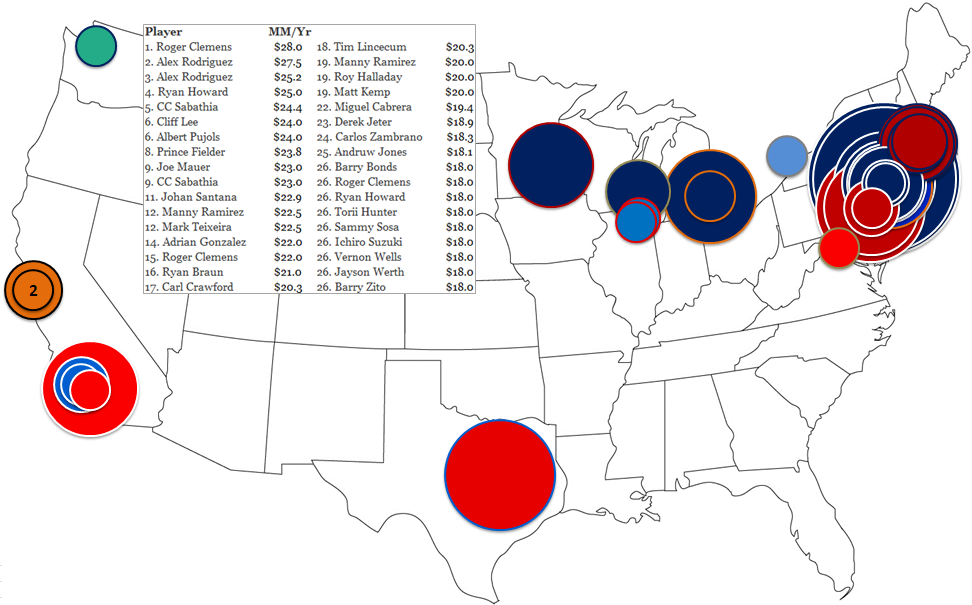
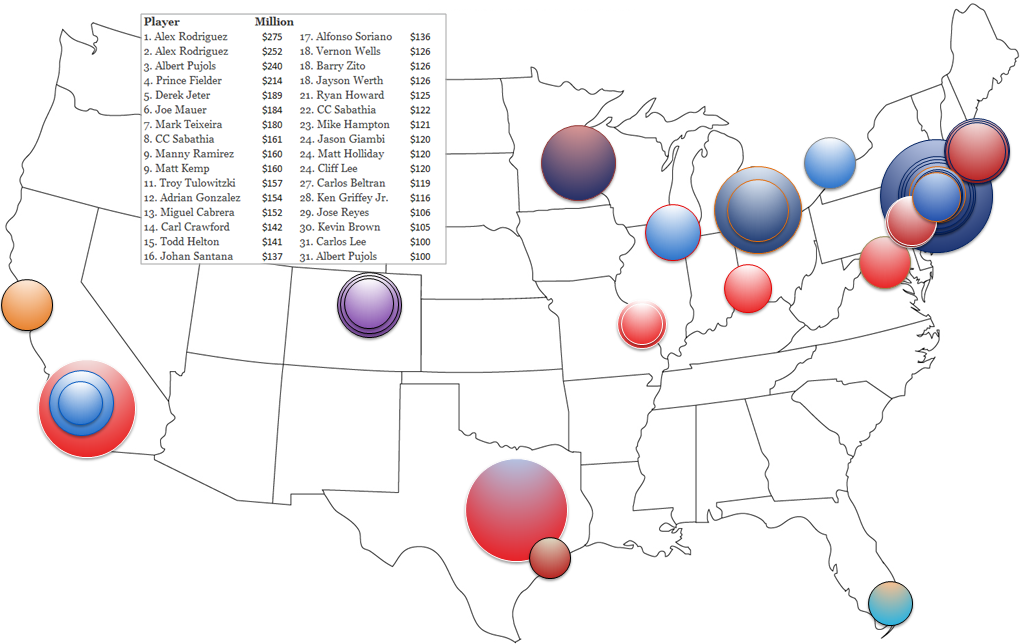
Given my affinity for maps, I started to wonder what it would look like to somehow capture the magnitude of baseball’s largest contracts in geographical form.  Here’s what I came up with:

32 Highest Contracts in History

UPDATE: The original map has been moved to the bottom of this post and replaced with this guy.  There are two reasons for this.  First, I had originally meant for each bubble’s *area* to correspond to the value of the contract, but thanks to some haste and some faulty thinking, I embarrassingly linked the contract value to the diameter (math degree: revoked).  However, after then realizing that sizing by area actually decreases the contrast in bubble size, I just ended up squaring the contract values and using those relativities.  At this point I don’t know that it has a mathematical meaning, but it makes for a more aesthetically pleasing map, and it’s easier to place the bubbles on top of each other.  New York is already overcrowded.

The second reason for the update is blog partner Zach weighed in with a new idea on bubble format, and I liked it.  Again, the original is below in case you’ve grown attached in the last 18 hours.

Each bubble represents a contract, with the size of the bubble being determined by the size of the contract, and the color and location of the bubble corresponding to the team.  I felt that labels would only muddy it up, so I listed the players/contracts represented in the top left.  I’ll let you match up contract with team.

Notable teams not represented: White Sox, Braves, Mariners.

Not surprising: Rays, Royals, Pirates, Athletics.

Original:
32 Highest Contracts in History

Larkin Represents ’90 Champs

A couple days late but Tyler Kepner had an outstanding piece in the Times on Tuesday, discussing the 1990 Reds and their first Hall of Fame inductee.  Apparently every World Series Champ before the wild card era had a player enshrined except the Reds, until Monday.

I know this is about Larkin, but I just love this quote from Eric Davis on his table-setting blast:

“I had faced [Stewart] in the All-Star Game,” Davis said. “He threw me a first-pitch fastball and I took it, and then he threw four splitters in the dirt and walked me. So if he was going to start me off with a fastball, I was not going to take it. And everything else is history.”

The whole thing is good.


Reds Payroll Pie Version 3.0

Bob spent some money last night…

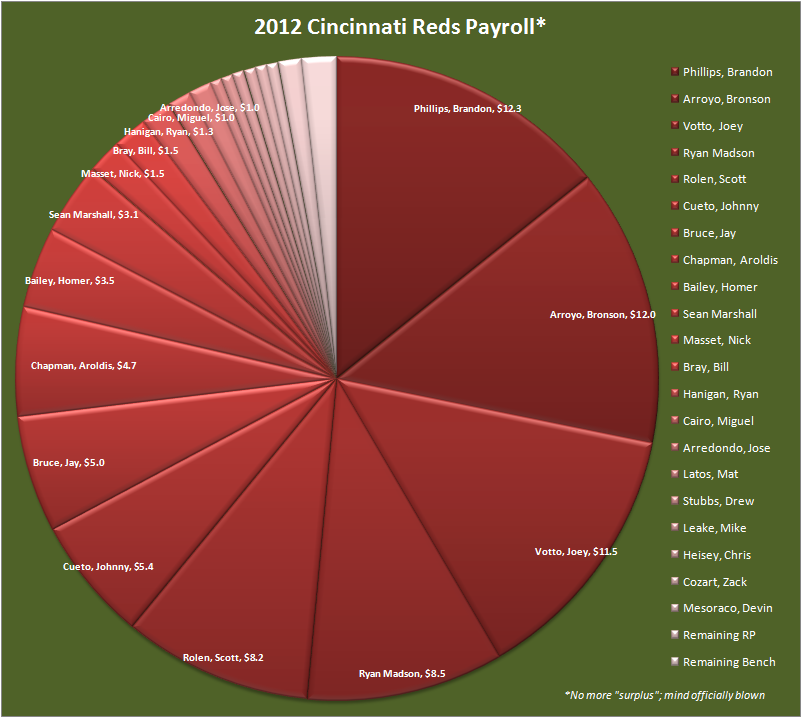
2012 Reds Payroll Pie 1-11-12

Of course, a few changes since last time:

  • Wood’s league-minimum salary is out.
  • Marshall’s $3.1 million makes a small dent; Madson becomes the 4th highest paid Red in 2012, nudging ahead of Scott Rolen.
  • Last time there was some fudging around bench players and relievers.  I don’t pretend to know who will round out the Opening Day roster, but I did limit it to 25 players this time, allowing for two more relievers and three bench players not listed by name.
  • Surplus is gone, folks.  Can’t say I’m aware of any master plan at this point.  Sounds like they still want a cheap veteran OFer.

The Reds clock in at around $86 million as of now, already a 6%-ish increase from last year.  Obviously a few million dollars in payroll doesn’t really affect fans directly, but if management is expecting more seats to be filled this year, I hope we can come through.  If I was in Cincinnati I’d be looking into some sort of season ticket package as we speak.

UPDATE: So as details around the Madson signing continue to leak out, Mark Sheldon reports that the 2012 figure is only $6 million(!!!), with a mutual option for 2013 of $11 million, and a $2.5 million buyout.  That’s $8.5 guaranteed, which is the number I cited above.  Not completely accurate, but you get the idea.

Chris Heisey’s Player Projection

In my last post I alluded to Chris Heisey’s impressive production in about half a season’s worth of plate appearances.  Thanks to a couple multi-homerun games, Heisey had 18 dingers, this after belting 8 round trippers in 226 PAs as a rookie.

Well, Fangraphs just released a set of player projections from RotoChamp.  I don’t really know anything about RotoChamp, except that they are one of the many sources for player projections, and apparently they’re good enough to meet Fangraphs’ standards.  Anyhow, the first rule when it comes to player projections is that there are always anomalies.  Usually, they come from younger players with limited sample sizes who turned in some sort of unsustainable trend.

Enter Chris Heisey.  Just out of curiosity I sorted by homeruns, descending, and sure enough, there’s Chris Heisey smashing 30 homeruns in under 500 plate appearances.  This ties him for 15th in all of Major League Baseball, matching some of baseball’s most promising young stars like Carlos Gonzalez, Troy Tulowitzki, Evan Longoria and Justin Upton.

Here’s to hoping.