Another look at contracts

On Wednesday I submitted a map that attempted to show the highest total value contracts in Major League Baseball history.  Predictably, New York was pretty crowded, but overall it played out well.

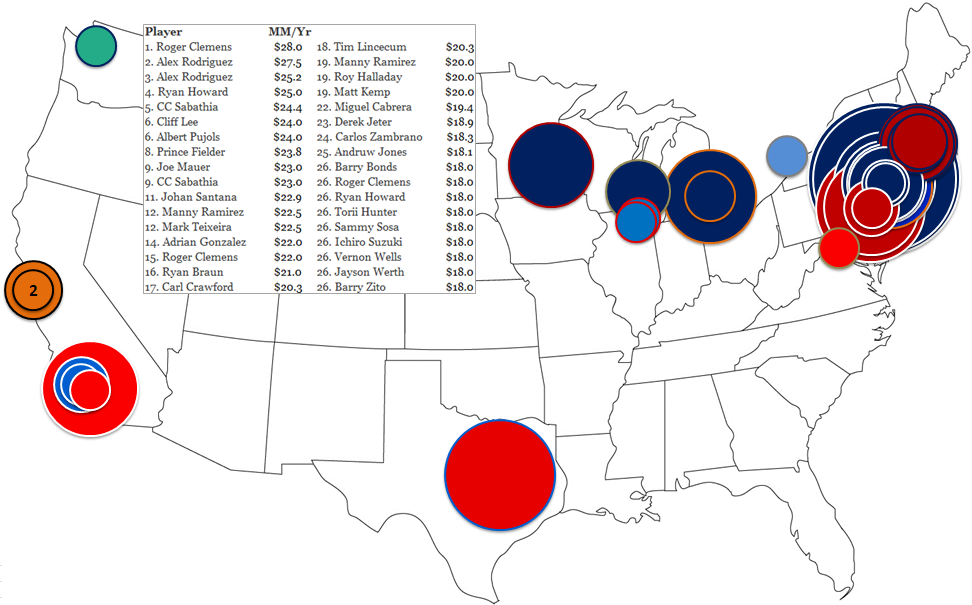
Yesterday, Twitter acquaintance Joel Luckhaupt (@jluckhaupt) wondered aloud what a map using the highest annual average contracts would look like, so I thought I’d find out:

Avg Ann Contract Value Map

Compare to previous map, if you like.

Some new teams are represented (Seattle, Milwaukee), though more were eliminated, which makes some sense considering dollars per season is a little more difficult for the mid and small market teams to get in on.  Overall it looks fairly similar in most cases, with the northeast getting even more attention.  There is less differentiation between bubble sizes this time around since we were working within a range of $18 – $28 million instead of $100 – $275 million.  Also kind of forgot about those one-year Clemens contracts.  Funny.

An enjoyable and enlightening process, again.

Filling out the roster…

I joined Twitter over two years ago almost as an afterthought.  I had dabbled with blogs a bit, but I wondered if this might be a better outlet for times when I wanted to write things that were mostly only important to me, but could be important to others, if only they were given a chance to read them.  Well, like with most things, you only get out of it what you put in, and I didn’t really put anything in.  I didn’t have much use for Twitter, most of my friends weren’t on Twitter, so things I wrote really weren’t getting to anyone.

In any case, in what seems like WAYYYY longer than the two years since, Twitter, at least for me, has exploded into the primary source for sporting news.*  I feel I’m not alone here.  Rob Neyer just wrote a delightfully creative post on the Prince Fielder signing according to Twitter.  I don’t think my Twitter feed is quite as active as Rob’s, which is somewhat by design.  Though I check it more now than I did several months ago, I felt that following too many people would be counterproductive.  When checking on an irregular basis, tweets from people I was really interested in would get lost in the sea of tweets from people I was only moderately interested in.  So, I chose who to follow with precise deliberation.  Among the shoo-ins were sources like Neyer, Posnanski, Fangraphs, Redleg Nation, etc.

*I don’t know if it was like this for other people before it was like this for me, but I do think the way Twitter is used now is a phenomenon that has developed in around the past two years, -ish.

Quickly, though, I realized that my horizons could be broadened by carefully selecting accounts slightly outside my comfort zone.  One of the first of these was Royals Authority, an intelligent baseball source with the right amount of snark and humor.  My roommate at the time was a Royals fan, and we all know that some of my favorite baseball people have connections to Kansas City, so it seemed to fit.  Another, was Bill Baer from Crashburn Alley, a Philly fan whose name I’d heard multiple times as I dug deeper into the world of internet baseball literature.

That was a really roundabout way of telling you that Bill posted something interesting yesterday, which prompted this interesting response four hours later, that Bill then retweeted…

Crashburn Alley Tweet

I couldn’t help but agree wholeheartedly with Miles Musselman.  And one of the reasons it is such a great name, in my opinion, is because it clearly is in reference to something somewhat obscure, and not in that, I know something you don’t and I’m going to rub it in your face kind of way, but in a, I bet that’s a really cool baseball story and I want to be a part of it, way.

So of course I went to Bill’s original tweet and clicked on his link, which took me to this, a reaction to the transaction from earlier this week that sent 26-year-old lefty reliever Jeremy Horst to the Phillies in exchange for utility infielder Wilson Valdez.  All those descriptors in front of those two names might indicate that this was a relatively minor move, and in most respects it is.  But when it comes to internet baseball literature, nothing is minor.

If you’ve made it this far, you clearly have all the time in the world to read any such thing you stumble upon in the internets, so I’ll go ahead and let you read the post yourself, which is quite interesting and goes into detail about the Reds’ newest acquisition (and this particular Philly fan’s opinion of him).  It doesn’t get me all that excited about the move, to be honest.  However, we are finally to the point where the title of this post actually makes sense.

This week saw the Reds take several steps toward filling out the 2012 roster.  One was getting a couple utility guys in Valdez and Willie Harris.  Personally, I understand the need for depth, though I’m not crazy about either.  I do admit that I haven’t taken the time to look into either guy.

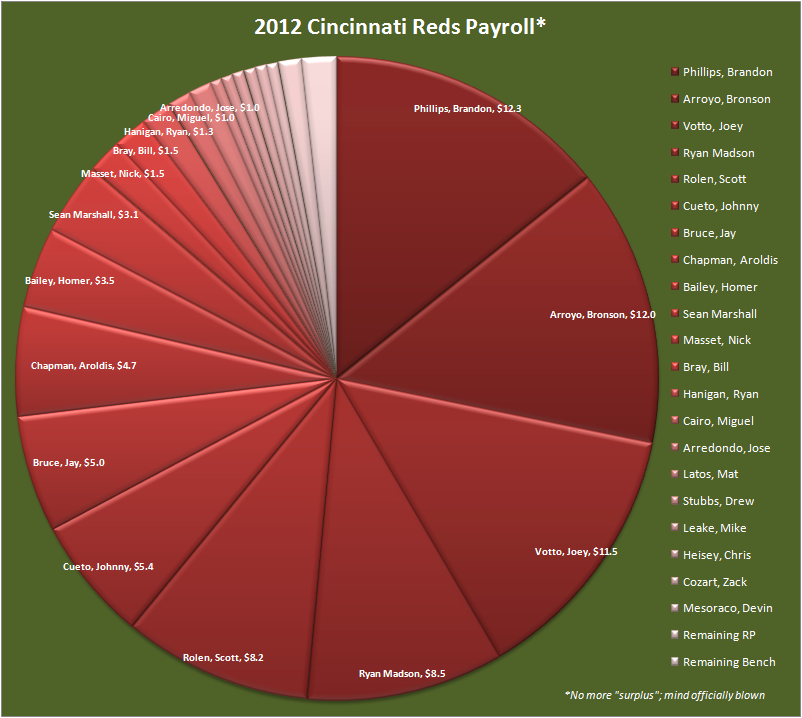
The Reds also settled matters with a couple arbitration eligible players, Nick Masset and Jose Arredondo.  This gave me a great idea: let’s go back and take a look at the pie to see if my salary guesstimates were anywhere close on the arb guys.

Player – Aaron’s 2012 Salary Guess – Actual 2012 Salary
Homer Bailey – 3.5 – 2.425
Nick Masset – 1.5 – 2.5 (part of a 2 year deal)
Bill Bray – 1.5 – 1.4175
Paul Janish – 0.5 – 0.85
Jose Arredondo – 1.0 – 1.0

I’m going to go ahead and say it – I did ok.  In the Payroll Pie article I admitted that I tried to stay conservative, which played out with Bailey.  He’s been inconsistent as a Red, and it showed in his first year of arbitration eligibility.

For Masset, I think (1) I put less value on relievers than the average baseball team, and (2) I probably got a little caught up in some of the anti-Masset clamoring that goes on in the comments of Redleg Nation, when in reality, if you look at Masset’s overall performance and his peripherals, he really is quite valuable, and I’d love to see him flourish in his newly defined, 7th-inning role this year.

Bray and Arredondo were nailed.  ‘Nuff said.

Janish I think I may have forgotten about.  There was talk that he wouldn’t even be tendered a contract, so I probably just filed him away and forgot to re-address (which isn’t to say I’m not happy he’s on the team).

All in all I think the roster is shaping up nicely.  These moves aren’t going to excite the fans, but they are the minutia that must get done each year, you know, for veteran leadership and whatnot.

Pujols, Fielder Contracts Pierce Top 5

Until Joe Mauer signed with his hometown team last off-season, the five richest contracts in baseball history were signed by active Yankee players (note: one was actually signed by A-rod to play for the Texas Rangers, but of course he’s now in pinstripes).

This off-season has brought three new faces into the top 10, including the third and fourth highest total value contracts ever.  In December the Angels locked up Albert Pujols for the next 10 years, and yesterday Prince Fielder and the Tigers agreed to a 9-year deal of their own.

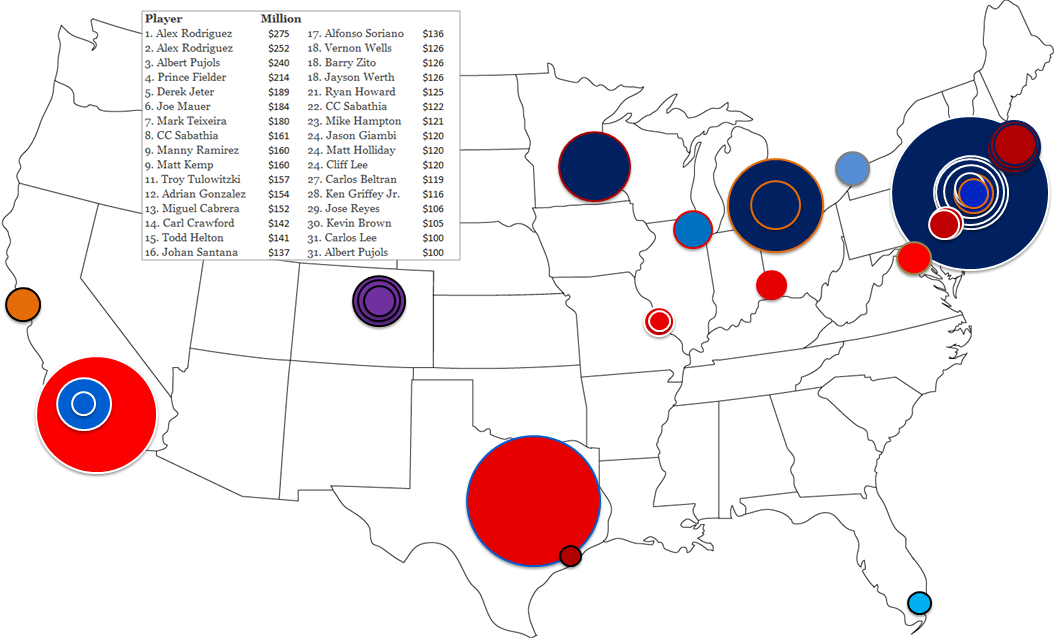
Given my affinity for maps, I started to wonder what it would look like to somehow capture the magnitude of baseball’s largest contracts in geographical form.  Here’s what I came up with:

32 Highest Contracts in History

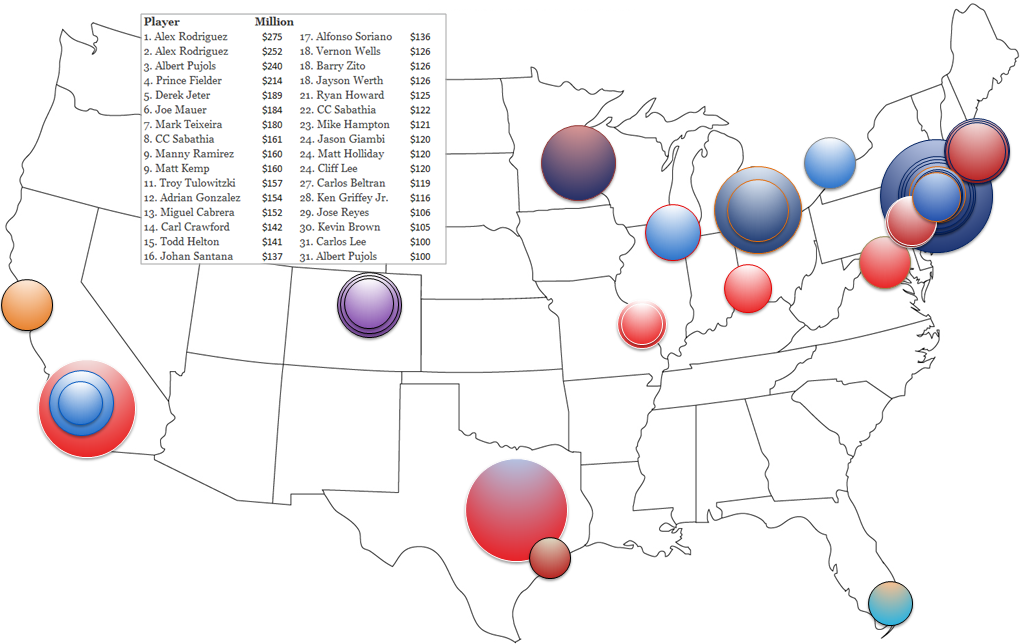
UPDATE: The original map has been moved to the bottom of this post and replaced with this guy.  There are two reasons for this.  First, I had originally meant for each bubble’s *area* to correspond to the value of the contract, but thanks to some haste and some faulty thinking, I embarrassingly linked the contract value to the diameter (math degree: revoked).  However, after then realizing that sizing by area actually decreases the contrast in bubble size, I just ended up squaring the contract values and using those relativities.  At this point I don’t know that it has a mathematical meaning, but it makes for a more aesthetically pleasing map, and it’s easier to place the bubbles on top of each other.  New York is already overcrowded.

The second reason for the update is blog partner Zach weighed in with a new idea on bubble format, and I liked it.  Again, the original is below in case you’ve grown attached in the last 18 hours.

Each bubble represents a contract, with the size of the bubble being determined by the size of the contract, and the color and location of the bubble corresponding to the team.  I felt that labels would only muddy it up, so I listed the players/contracts represented in the top left.  I’ll let you match up contract with team.

Notable teams not represented: White Sox, Braves, Mariners.

Not surprising: Rays, Royals, Pirates, Athletics.

Original:
32 Highest Contracts in History

Larkin Represents ’90 Champs

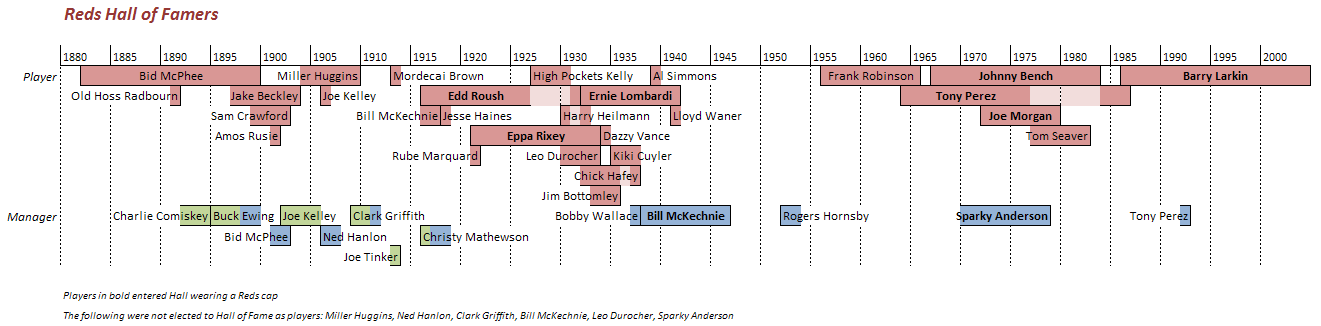
A couple days late but Tyler Kepner had an outstanding piece in the Times on Tuesday, discussing the 1990 Reds and their first Hall of Fame inductee.  Apparently every World Series Champ before the wild card era had a player enshrined except the Reds, until Monday.

I know this is about Larkin, but I just love this quote from Eric Davis on his table-setting blast:

“I had faced [Stewart] in the All-Star Game,” Davis said. “He threw me a first-pitch fastball and I took it, and then he threw four splitters in the dirt and walked me. So if he was going to start me off with a fastball, I was not going to take it. And everything else is history.”

The whole thing is good.


Reds Payroll Pie Version 3.0

Bob spent some money last night…

2012 Reds Payroll Pie 1-11-12

Of course, a few changes since last time:

  • Wood’s league-minimum salary is out.
  • Marshall’s $3.1 million makes a small dent; Madson becomes the 4th highest paid Red in 2012, nudging ahead of Scott Rolen.
  • Last time there was some fudging around bench players and relievers.  I don’t pretend to know who will round out the Opening Day roster, but I did limit it to 25 players this time, allowing for two more relievers and three bench players not listed by name.
  • Surplus is gone, folks.  Can’t say I’m aware of any master plan at this point.  Sounds like they still want a cheap veteran OFer.

The Reds clock in at around $86 million as of now, already a 6%-ish increase from last year.  Obviously a few million dollars in payroll doesn’t really affect fans directly, but if management is expecting more seats to be filled this year, I hope we can come through.  If I was in Cincinnati I’d be looking into some sort of season ticket package as we speak.

UPDATE: So as details around the Madson signing continue to leak out, Mark Sheldon reports that the 2012 figure is only $6 million(!!!), with a mutual option for 2013 of $11 million, and a $2.5 million buyout.  That’s $8.5 guaranteed, which is the number I cited above.  Not completely accurate, but you get the idea.

Chris Heisey’s Player Projection

In my last post I alluded to Chris Heisey’s impressive production in about half a season’s worth of plate appearances.  Thanks to a couple multi-homerun games, Heisey had 18 dingers, this after belting 8 round trippers in 226 PAs as a rookie.

Well, Fangraphs just released a set of player projections from RotoChamp.  I don’t really know anything about RotoChamp, except that they are one of the many sources for player projections, and apparently they’re good enough to meet Fangraphs’ standards.  Anyhow, the first rule when it comes to player projections is that there are always anomalies.  Usually, they come from younger players with limited sample sizes who turned in some sort of unsustainable trend.

Enter Chris Heisey.  Just out of curiosity I sorted by homeruns, descending, and sure enough, there’s Chris Heisey smashing 30 homeruns in under 500 plate appearances.  This ties him for 15th in all of Major League Baseball, matching some of baseball’s most promising young stars like Carlos Gonzalez, Troy Tulowitzki, Evan Longoria and Justin Upton.

Here’s to hoping.

Walt’s Gone Mad(son)

It has been quite the whirlwind off-season for this team.  Let’s recap…

Gone: Wood, Volquez, Alonso, Grandal, Sappelt, Boxberger
Here: Mat Latos, Sean Marshall, Ryan Madson

That last one definitely came out of left field (literally).  We’ve been hearing rumors that Walt was talking with Francisco Cordero for somewhere in the neighborhood of 7 or 8 million.  I think most people, including myself, were not in favor of that arrangement, mostly due to Coco’s loss of effectiveness (last year was a mirage), the perceived bigger need for another bat, and the notion that big money should not be spent on a guy just because he’s been labeled a “closer”.

Ryan Madson is much better than Francisco Cordero, and despite the fact that those last two points still apply, I’m excited about the addition.

The thing that makes this signing better than signing any ol’ closer for too much money is that Madson, and Marshall for that matter, are legitimately very good (relief) pitchers.  They strike guys out, and they don’t give up too many walks or homeruns.  That is a sure fire recipe for success (and I’m sorry, but it bothers me a little when people say that these guys are built for GABP… that’s like saying a hitter is good for GABP because he hits the ball 500 feet and steals a lot of bases… that just makes you a good player, in any ballpark).

I know the research tells me otherwise, but like most fans, I like the comfort of knowing we have two legitimate weapons waiting at the end of each game.  The one excuse for Coco’s recently completed, four-year contract that actually spoke to me a little bit is that the Reds’ bullpen was a disaster before he arrived.  Yes it was a horrific overpay, and for too many years, and nothing changes that.  But the (very faint) silver lining was that it was one less thing to worry about, and (watch out I’m about to put stock in an intangible) whether or not it actually affects results, not having faith in your bullpen is a terrible thing, and I can’t imagine players enjoy putting up with it.

Now, some stats: Sean Marshall has the most WAR of any reliever in baseball over the last two years.  Ryan Madson has the 9th lowest FIP among relievers who’ve averaged more than 40 IP over the last two yeras.  These guys are good.

If there’s something that bothers me just a little, it’s that the Reds just committed 13.1 million dollars to two relief pitchers.  Early in the off-season I was of the mindset that the Reds shouldn’t dedicate any more money to their bullpen, asserting that assembling a cheap but effective bullpen is easier than finding cheap and effective players anywhere else, and that middling extra starters (which the Reds had) can often be converted into very effective relief pitchers.  Funnily enough, both acquisitions are converted starters.

Instead of spending the money on the bullpen, the Reds could have made a different sort of splash by signing Carlos Beltran (he got $13 million a year from St. Louis).  People are worried about his age/health, and they are right to worry.  One could also worry about investing in relief pitchers, who not only play a limited role on the team but also have a tendency to be finicky.  Relievers come and go, often having two or three very good, even dominant years before quickly losing effectiveness.

Honestly though, as I’m writing through it all, I might prefer Madson/Marshall to Beltran.  The relief combo will be plugged into a bullpen that collectively earned 1 win above replacement last year.  ONE.  The Reds’ closer had 0.1.  Several others were negative.  It shouldn’t be hard for the Reds to replace those replacement level players and reap the maximum benefit from these two signings.

On the other hand, Chris Heisey is currently penciled into left field.  In around 300 PA last year he accumulated 1.6 WAR.  Heisey could have a better year than Beltran, we don’t know.  He hasn’t experienced the workload of a full time starter yet in his career, so there is definitely some uncertainty.  However, left field isn’t the black hole that some would have you believe.

In case it hasn’t been said enough, the Reds are all in for 2012.  This was a bold move, and a lot of money to spend on a guy who will probably pitch exclusively in the 9th inning.  But man do I love the attitude the Reds are taking this off-season.  They want to win, and they are addressing needs, and they are spending money to do it.  More money than I ever thought they’d spend for this year.  I haven’t been this excited about a Reds team in a very long time.

Barry Larkin

Barry Larkin was voted into the Hall of Fame yesterday.  Seven years ago I wasn’t sure this day would come.  I remember scouring ESPN.com when Larkin retired, trying to figure out if the experts agreed with the entire city of Cincinnati on their shortstop’s Hall of Fame credentials.  I likely turned to Rob Neyer first, though if I remember correctly his take wasn’t much different than most: Larkin deserved to get in, and it wasn’t all that close.  Whether the writers would vote him in is a different story.  As has been chronicled more times than I can count over the last several days/months/years, for some reason Larkin didn’t stand out.  Most commonly, it’s blamed on the fact that he was good at everything, and not transcendently great at any one thing.  My personal bias is that Ozzie Smith’s legend, which I maintain helped him win a couple extra Gold Gloves in his twilight years that probably should have gone to Barry, kept the Reds shortstop under the radar.  Whatever the reason, whenever Larkin’s Hall of Fame case came up, I started sweating.

But a funny thing happened on the way to Cooperstown.  More accurately, millions of tiny little things having been happening and continue to happen, which are slowing beginning to shape the way many people look at baseball.  The internet continues to find new ways to gather and deliver information.  Very smart people who would otherwise have no outlet, now have a voice.  And I think these smart people started talking about Barry Larkin’s Hall of Fame credentials, and then other smart people started noticing.  And soon, even the not smart ones started to think: “Hey, this Larkin guy was pretty good.”  Or maybe they thought: “Wow, everyone seems to like him.  Seems like a good enough reason for a ‘yes’ vote.”  We can’t really be sure.

Point is, in the weeks leading up to the vote, I was much less worried about the results than I had been in the past.  It seemed that support had swelled, and before it actually happened, everyone knew that Larkin would be inducted in 2012 before a wave of great players entered the pool in 2013, 2014 and 2015.

So when it happened, I was happy.  But I was also really busy at work, and when I finally found the time to look out on the interwebs and see what I could see, I got kinda bored.  All these people talking about Larkin as if I didn’t know who he was and what he had done.  Jim Bowden and his lame home video, telling generic stories and recalling his connection to our team when it was convenient for him to do so.  These things did not interest me.

***

Barry won his MVP when I was 12 years old.  Not long after that season I remember going with my parents to the Bigg’s in Eastgate to get a limited edition poster, a full-body illustration of Larkin following through on a toss to a teammate.  I came home and put it up on the ceiling above my bed, not because I wanted to look up at our star every night before falling asleep, but because all my other wall space was filled.  Honestly, though, had it been any other poster I don’t think I would have given it such a front-and-center location.  I ended up staring that that thing an awful lot.  It had his 1995 MVP-winning stats listed along the bottom, which still stand out to me today.  13 homeruns.  66 RBI.  A few years later, when players were routinely hitting 60 and 70 homeruns, it seemed both remarkable and perplexing that Larkin was able to win.  I always though it was funny, too, that the next year he became baseball’s first ever 30/30 shortstop, posted a career best OPS+ of 154 with a .298/.410/.567 slash line, won the Gold Glove, and finished 12th in MVP voting.

***

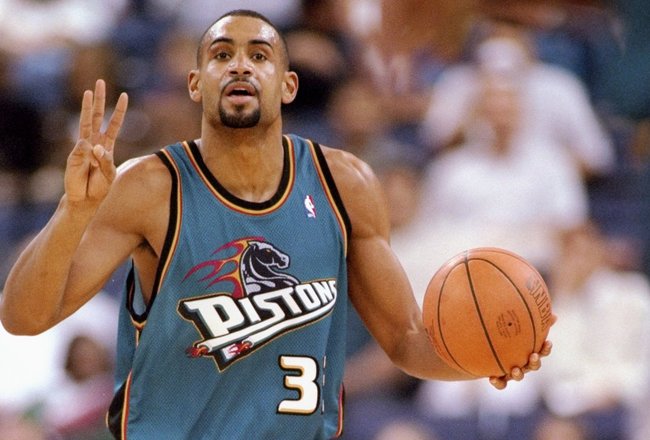
For some reason I never had a baseball jersey growing up.  I had several football ones, but they were mostly afterthoughts (including a Marino jersey that was probably on sale at All About Sports).  In all honesty, basketball was my favorite sport growing up, and my jersey collection was evidence of that.  Aside from the three Nick Van Exel Laker jerseys, my favorite was probably a Grant Hill from Detroit’s short lived teal era.

I do have one baseball jersey now.  Several years ago when I had a birthday coming up, it had become clear to me that I had no Reds jerseys, and that was weird.  I thought of the players on the team, and though my fandom was as intense as ever, no one really jumped out at me as the guy I wanted to wear around GABP.  No, I wanted a jersey that was inspired by greatness, that represented this team’s proud history.  And now, I know exactly what I’ll be wearing in Cooperstown on July 22nd.

Reds Pitching: What happened, and is it fixed?

Most Reds fans will tell you that the big concern this off-season was pitching.  Sure, shortstop and left field are routinely identified as “areas of need”, but those are more of a luxury.  The Reds have solidly been a top 5 offense in the NL the past 2 years.  No, what hurt them last year was pitching, and this isn’t news.  But, if you know me, you know I like to put numbers to pretty much anything, so here you go:

Reds Pitching Compare

This is a basic breakdown of the team’s performance in the major categories: hitting, pitching and defense (and I guess baserunning, but as you will see, that isn’t really “major”).

The first thing you might notice is that pitching isn’t the only thing that suffered in 2011.  The Reds’ offense lost more than 6 wins.  Well, that may be a bit misleading.  First, you might assume that even though both Batting and Pitching WAR went down, 33 is still higher than 7.  And you’d be right, by a lot.  This observation also plays out when you compare with the rest of the league.  In 2011 the Reds were still second in the NL (behind the Cardinals) in offensive WAR.  They were 14th in pitching WAR.  The only reason 2011 seems like a drop in offensive output is because the Reds went ballistic in 2010, beating out the second place Brewers by almost 7 wins.  They were a virtual lock to go down in 2011.

So anyway, back to pitching.  Seven wins is not good.  It’s especially disappointing when you consider all the praise the Reds’ staff was getting before the season because of its depth.  Seven or eight viable starters.  When’s the last time Reds had such a stockpile?  One or two are bound to develop into a staff ace!
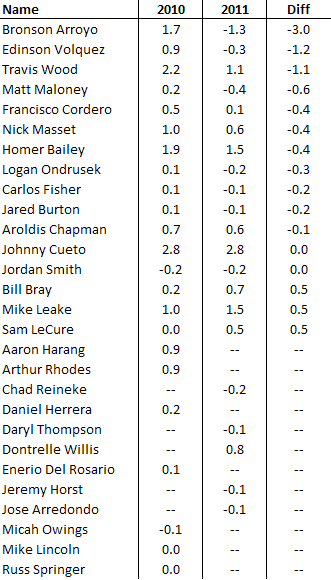
Reds Pitching Player CompareWell, not quite.  Cueto turned in a good year.  But an injury limited him to 24 starts, and as you can glean from other materials on this site, he may not have quite reached “ace” status.  Mike Leake, Homer Bailey, Travis Wood, and the out-of-nowhere Dontrelle Willis were also not bad, but not enough to make up a division winning middle-of-the-rotation, as the Reds only got 79 starts and 4.9 WAR among the four.

But the real problem with 2011 was Bronson Arroyo and Edinson Volquez.  The pair combined for -1.6 WAR in 52 starts.  Think about that for one more minute.  Nearly a third of the Reds’ starts were spent on guys who cost the Reds 1.6 wins.  That’s not compared to the average major leaguer.  That’s compared to the average replacement player (i.e. someone called up from AAA or random free agent guy).  This is somewhat mind blowing.

But ok, let’s relax a little.  (Breath.)  2011 is over.  2012 is a new year, and the Bronson Arroyo that Reds fans have come to know and love is dedicated to becoming the dependable innings-eater he had been for years.  While encouraging, I don’t think we can count on Arroyo becoming a middle-of-the-rotation guy.  At best he can be a serviceable 4/5.  But I do think he can do it, and there’s at least a chance he performs even better.

So that’s one down.  Next up: Volquez.  He gone (sorry, lived in Chicago too long).  But seriously, I hope he turns it around somewhat in San Diego (not too much though). I honestly won’t be too broken up about it, because no matter what happens, EV’s time in Cincinnati was done.  There was really no coming back from that situation.

So let’s stop dwelling in 2011 and look ahead.  We know what happened in 2011.  What’s going to happen in 2012?  Have the Reds put themselves in position to contend again?

OK, so it’s impossible to say.  But let’s make the best guesses possible.

Reds starters went from 11.4 WAR in 2010 to 6.1 WAR in 2011.  Can we return to double-digits?

First, the aces.  Cueto has hovered just below 3 the last two years.  Considering he is still just 26, and we’re hoping for a full season out of him, I’m going to go ahead and give him the 3.  Now obviously he could go higher (we hope), but there’s also the possibility that he regresses/gets hurt again/etc.  3 seems reasonable.

Mat Latos touched 4 wins above replacement as a 22-year-old.  His 2011, when he turned in just over 3, has been documented.  Many think Latos could turn into one of the best pitchers in the NL.  But since there are question marks, I don’t want to count on him for too much here.  I’m giving him 3.5, which could be conservative, but I’d rather be pleasantly surprised than disappointed.

Already we’re surpassing last year’s total.  That leaves Leake, Bailey, Chapman and Arroyo for the last three spots.  Something tells me Arroyo will be making 30+ starts, which is probably fine because we’ve now traded away much of our starting pitching surplus, and Chapman will be a big question mark.  Bailey has been taunting Reds fans for years, but despite his frustrating tendencies, he has shown he can be effective.  I was hoping we’d get a better read on him last year, but that didn’t happen.  He has gotten close to 2 WAR with around 20 starts each of the last two years, so I’m going to go ahead and give it to him.

I’m giving the same to Leake, who is entering just his third major league season, and can be expected to continue to steadily improve.

We’ve covered Arroyo, and as optimistic as I may have sounded, I’m giving him zero wins above replacement.  It sounds low, but consider, that’s an improvement of more than a win – no easy task.  Granted, he was bad enough last year that it shouldn’t be as difficult as it sounds, but the guy is what, 35?  And his strikeout rate continues to go down.
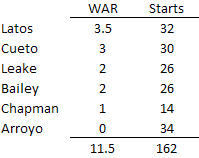
Reds Pitching 2012 PredictionSo where does that leave us (by the way, I gave Chapman ‘ah’ win)?  11.5.  Right around 2010 levels.  Of course, these are very rough estimates.  Anything can happen.

That’s not all though, right?  The Reds now have an experienced 8th-inning guy who will transform the bullpen (or something like that).  Sean Marshall has been a brilliant back of the bullpen guy for the Cubs, and actually had more wins above replacement over the last two years (5.0) than the entire Reds bullpen (4.8).

Every time I think about doing an analysis like this, I start to get discouraged.  That’s because I almost feel foolish making the implication that we have any idea what’s going to happen next year.  What improves our chances though, is focusing less on individual players, and more on the team (you know, law of averages and all that).   So while I might have been more aggressive with Leake and Bailey, I was conservative with the rest, which hopefully adds up to a decent projection.  And of course, we haven’t even touched the rest of the team.  Some of that was by design… much of the offense will stay the same, which means the defense will stay the same.  Maybe Mesoraco contents for Rookie of the Year.  Maybe he struggles.  Maybe Stubbs bounces back.  I will say that there’s a lot of room for improvement.  2011 was a down year.

Topic for next time: why have the Reds so underperformed their expected win total based on WAR?  Dusty Baker anyone?

(P.S. Many of the WAR predictions made here were helped by the very cool player projection tool over at Fangraphs.  You can select certain stats for each player for the upcoming year and it calculates a corresponding WAR.  It includes stats for the last several years to help you out too.  I highly recommend it.)